
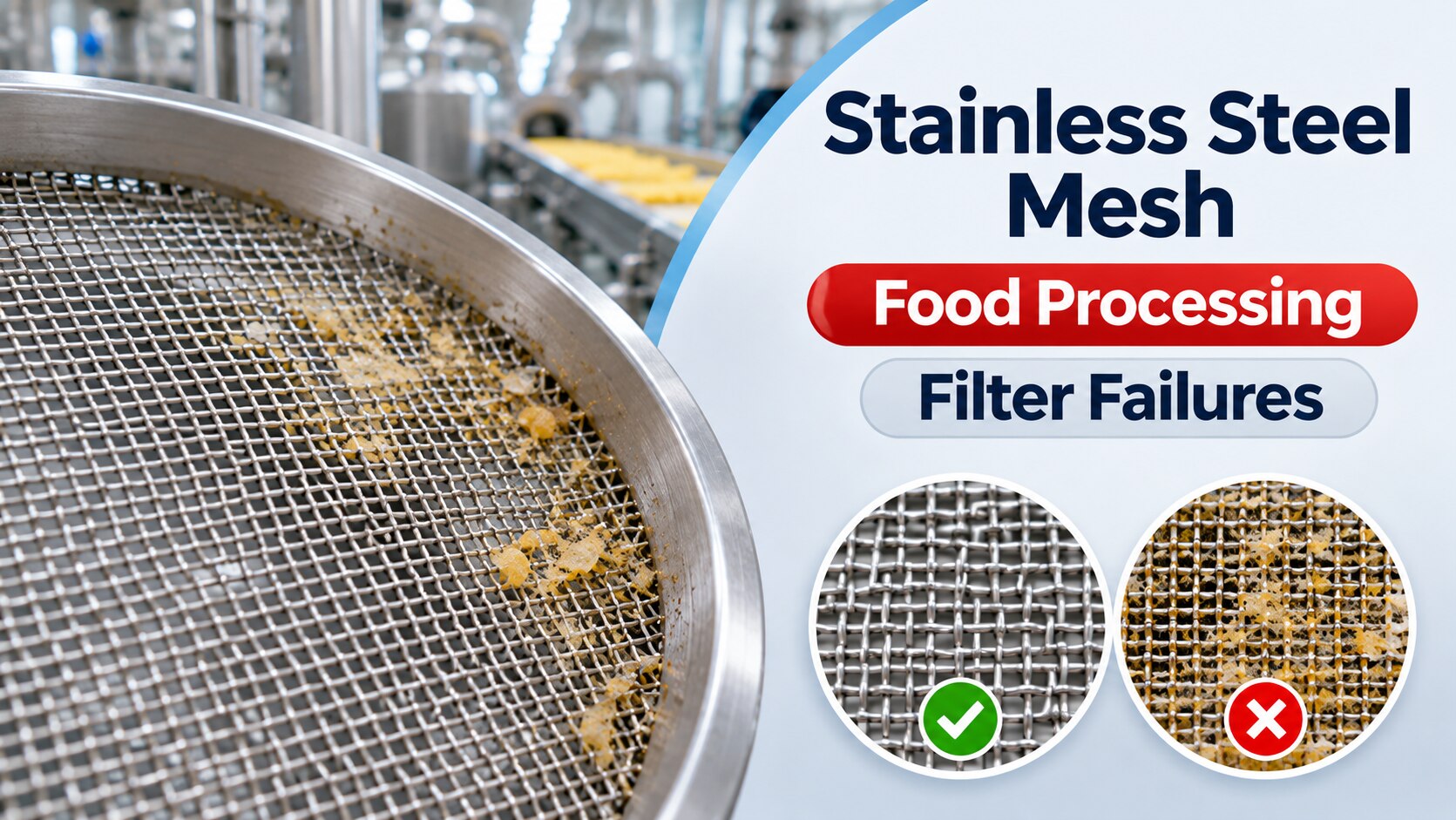
A stainless steel filter can plug, corrode, deform or leak product even when its material grade and mesh count appear correct. By tracing the failure to particle loading, aperture selection, chemistry, pressure, fabrication and cleaning, you can separate a mesh-design problem from a process problem and write a specification that prevents repeat failures.
Key takeaways
- Separate blinding, corrosion and mechanical failure before changing mesh.
- Specify aperture, wire diameter, alloy, pressure and cleaning method—not mesh count alone.
- Choose SS 316 for the actual chemicals and temperatures, not as a universal fix.
- Include installation, hygiene and inspection requirements in every replacement order.
Is the filter blinding, corroding or mechanically failing?
A rapid differential-pressure rise with falling flow points to blinding when the wires remain intact. Fibres, starches, proteins, fats, sticky solids and deformable particles form a cake over the surface. High solids loading, high viscosity, excessive velocity and inadequate cleaning accelerate it.
Corrosion leaves pits, roughness, rust-like staining or enlarged openings. Chloride from salt, brine, hard-water deposits, evaporated product and hypochlorite residue concentrates at wire crossings, support rings and gasket contact areas. Pitting releases metallic particles and creates surfaces that retain food and microorganisms.
1. Inspect the used filter for the failure pattern. Blinding leaves an intact cloth covered with retained solids; mechanical failure shows torn cloth, broken or displaced wires, collapsed unsupported spans, opened seams or failed welds.
2. Compare the pressure trend with retained solids and cleaning records. If pressure rises while the filter is clean and undamaged, investigate particle loading, viscosity, velocity and cleaning before ordering a finer mesh.
3. Check downstream particle counts. Abrasion from sugar, salt, crystals, pigments or fast-moving slurry can enlarge apertures gradually while the mesh remains bright. Rising counts indicate wire thinning before visible damage.
4. If openings are enlarged or the frame has separated, investigate support, pressure cycling, vibration, impact and fabrication. Do not treat a grade change as the cure.
This diagnosis matters when selecting stainless steel mesh for filter problems in food processing in Ahmedabad or sourcing food processing filter mesh in Ahmedabad: identify blinding, corrosion or mechanical failure first, then specify the replacement.
Why mesh count alone produces the wrong filtration result
A “100 mesh” order does not identify the opening. For plain square weave, aperture in millimetres is approximately 25.4 divided by mesh count, minus the wire diameter. Two cloths sold as 100 mesh can therefore have different apertures, open-area percentages, pressure drops and flow capacities.
| Weave | Filtration behaviour | Main trade-off |
|---|---|---|
| Plain square weave | Easier to interpret; particles larger than the aperture are primarily retained | Useful flow, but near-aperture particles can pass, deform or lodge at crossings |
| Dutch weave | Finer effective retention structure | Higher pressure drop and lower flow capacity |
State the separation objective: nominal retention, absolute retention or a process-specific particle-size limit. A finer opening is not automatically better. Fibres, starches, proteins, fats and deformable solids can blind it faster, raising differential pressure and reducing throughput; cleaning also becomes harder.
Specify these details instead of “fine mesh”:
- Aperture in millimetres and tolerance
- Wire diameter, weave, thickness and open-area percentage
- Material grade, such as an SS 304 wire mesh filter or SS 316 wire mesh food filtration
- Inspection method, with ISO 9044 as a recognised framework for woven-wire-cloth characteristics and inspection
- Particle-size distribution, solids loading, viscosity and required throughput
If stable pressure drop matters, add prefiltration or a support arrangement rather than simply reducing the aperture. A cloth that matches the particle-size limit but lacks open area can fail hydraulically before it fails as a separator.
When SS 304 fails and SS 316 is still not enough
SS 304 wire mesh filter material suits many dry products and low-chloride aqueous duties, but choose the grade from chemical exposure rather than the product name. SS 316 wire mesh food filtration is stronger against chloride pitting and crevice corrosion because molybdenum improves resistance, but it is not corrosion-proof.
| Grade | Suitable exposure | What can still cause failure |
|---|---|---|
| SS 304 | Dry products and low-chloride water-based service | Salt, brine, acidic ingredients, chlorides and aggressive cleaners can cause pits, staining and enlarged openings |
| SS 316 | Chloride exposure, salt, brine, acidic ingredients and aggressive cleaning chemicals | Concentrated brine, deposits, stagnant zones, hot chloride solutions and oxidizing cleaners can still attack it |
Record product pH, chloride concentration, operating temperature, sanitation temperature, cleaner identity and concentration, exposure time, and rinse quality. Inspect welded frames separately from the woven cloth: excessive welding heat can cause sensitization near the heat-affected zone, while carbon-steel tools, abrasive particles, weld scale and heat tint can introduce iron contamination.
- Clean and descale contamination before applying a passivation treatment matched to the fabrication condition.
- Do not expect passivation to repair poor weld finishing or remove an ongoing chloride source.
- Do not expect a 304-to-316 upgrade to cure blinding, an incorrect aperture, weak support, gasket bypass or pressure cycling.
A failed frame can corrode while the woven wire looks intact. Treat chemical resistance, hydraulic performance and mechanical design as separate controls.
How pressure, installation and hygiene turn good mesh into a bad filter
Treat the mesh, support and housing as one mechanical and hygienic assembly: excessive differential pressure can stretch wires, displace them, open seams or collapse cloth into the support grid. Unsupported spans, pump pulsation, vibration, impact loading and repeated pressure cycles fatigue clamps, welds and edges.
Reverse-flow cleaning can tear cloth without a support layer or a screen pack suited to that duty cycle.
Incorrect gasket placement creates edge bypass, while a loose frame lets unfiltered product pass around the cloth. Inspect these failure points:
- The seal line, support contact, edge construction, maximum differential pressure and flow direction.
- Crevices at frames, poorly finished welds, sharp cut wire ends, folded edges, lap joints, dead legs and non-drainable pockets.
- Narrow openings or mesh trapped between supports, where product remains despite a visually clean filter.
A food-contact assembly must be drainable, inspectable and cleanable. EU Regulation (EC) No 1935/2004 requires food-contact materials not to transfer constituents in harmful quantities or adversely affect food. For food processing filter mesh in Ahmedabad, request evidence covering material grade, aperture tolerance, weld finish, surface condition, pressure rating, cleaning method and certificate requirements.
A bright surface proves none of these controls.
What to put in a replacement specification before ordering
Put the duty in numbers before asking for a replacement. Give Laktas Wire Mesh Pvt.Ltd. Mr. Pramod K. the failed filter, retained solids, pressure trend and cleaning record, not just “100 mesh”; that evidence separates a cloth problem from blinding, bypass or support failure.
- State the fluid, solids and particle-size distribution; target retention as nominal, absolute or process-specific; flow rate; viscosity; operating and maximum temperature; pH; chloride concentration; cleaner, sanitizer, sanitation temperature, exposure time; design and maximum differential pressure; flow direction; cleaning method; and pressure-cycle count.
- Specify aperture in millimetres, wire diameter, open-area percentage, weave, thickness, SS 304 or SS 316 grade, aperture tolerance, edge construction, support arrangement, gasket location and test method. Require ISO 9044-based aperture inspection, material certificates, certificate requirements and a finished-assembly pressure test.
For stainless steel mesh for filter problems food processing in Ahmedabad, compare suppliers on construction evidence rather than local stock labels:
| Supplier evidence | Why it matters | Reject if missing |
|---|---|---|
| Drawing | Shows aperture, supports, edges and gasket position | Dimensions remain verbal |
| Inspection report | Confirms aperture, wire and tolerance | Only “100 mesh” appears |
| Material certificate and weld photographs | Verifies grade and fabrication condition | No heat-affected-zone evidence |
| Cleanability details | Exposes crevices, trapped mesh and drainability | Cleaning method is unspecified |
The same checks apply when sourcing food processing filter mesh in Ahmedabad. Validate visually, review cleanability and check downstream particles; change one control at a time so upgrading 304 to 316 is not mistaken for curing hydraulic or hygienic failure.
Related products
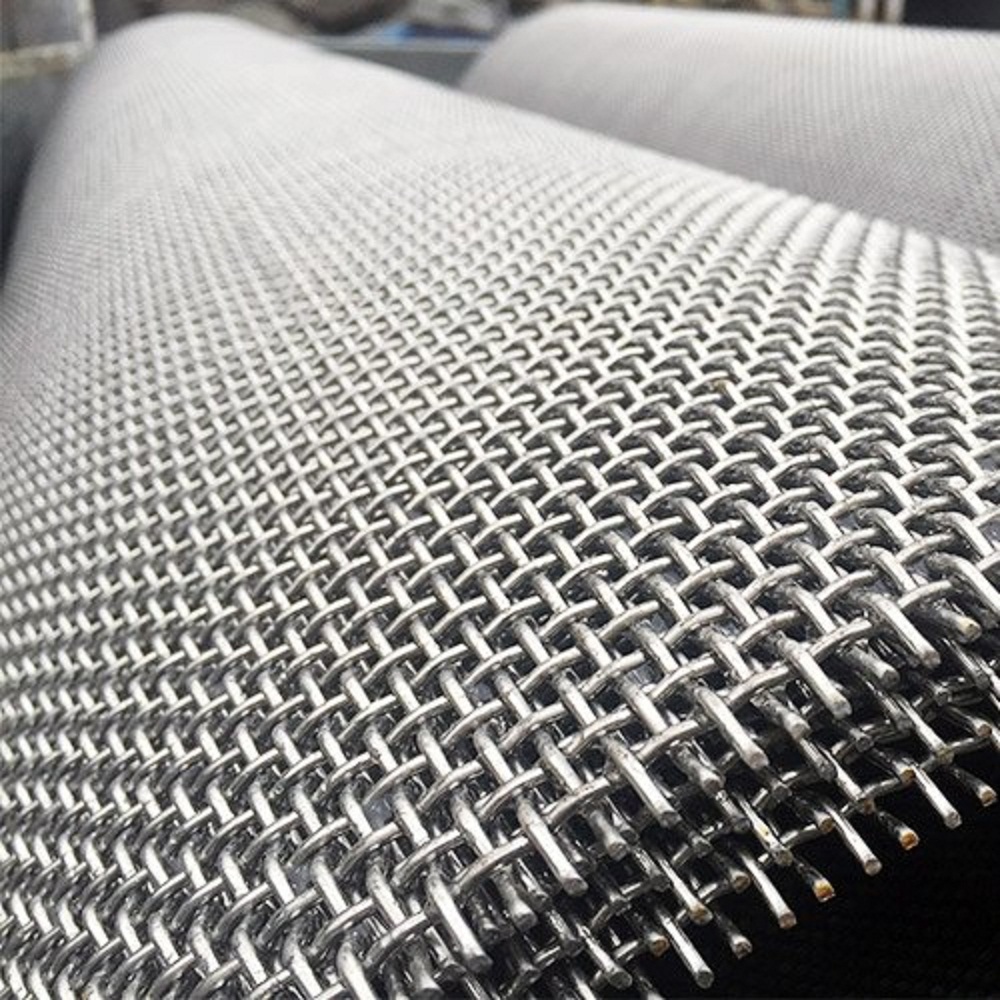 | Wire Mesh Laktas wire cloth is highly useful in filtration industries because it provides a reliable, durable, and customizable solution for separating solids... View product → |
 | ₹30 Micro filters discs are available in single and multiple layers with & without frame, multiple layers with spot welding. View product → |
Frequently asked questions
How can you tell whether a food processing filter is blinding, corroding or mechanically failing?
A rapid differential-pressure rise with falling flow and intact wires indicates blinding. Pitting, rust staining or wire loss indicates corrosion. Tears, stretched openings, broken welds or collapsed supports indicate mechanical failure.
Why does mesh count alone produce the wrong filtration result?
Mesh count does not specify the opening size, wire diameter, open area or particle-retention behaviour. Compare the nominal aperture, wire diameter, weave and required flow rate instead.
When does SS 304 fail, and is SS 316 always enough?
SS 304 can fail in chloride-rich, acidic or aggressive cleaning environments. SS 316 offers better resistance because of its molybdenum content, but it can still fail when chemical concentration, temperature, exposure time or crevice conditions exceed the alloy's limits.
How do pressure, installation and hygiene damage a stainless steel food filter?
Excess differential pressure stretches or tears mesh, while poor support, incorrect sealing and vibration create bypass or fatigue damage. Inadequate cleaning leaves product deposits that harden, harbour contamination and accelerate corrosion.
What should a replacement stainless steel mesh specification include?
State the alloy grade, nominal aperture, wire diameter, weave, dimensions, support arrangement, gasket material, operating temperature, pressure limit, flow rate, product characteristics, cleaning chemicals and inspection requirements.