
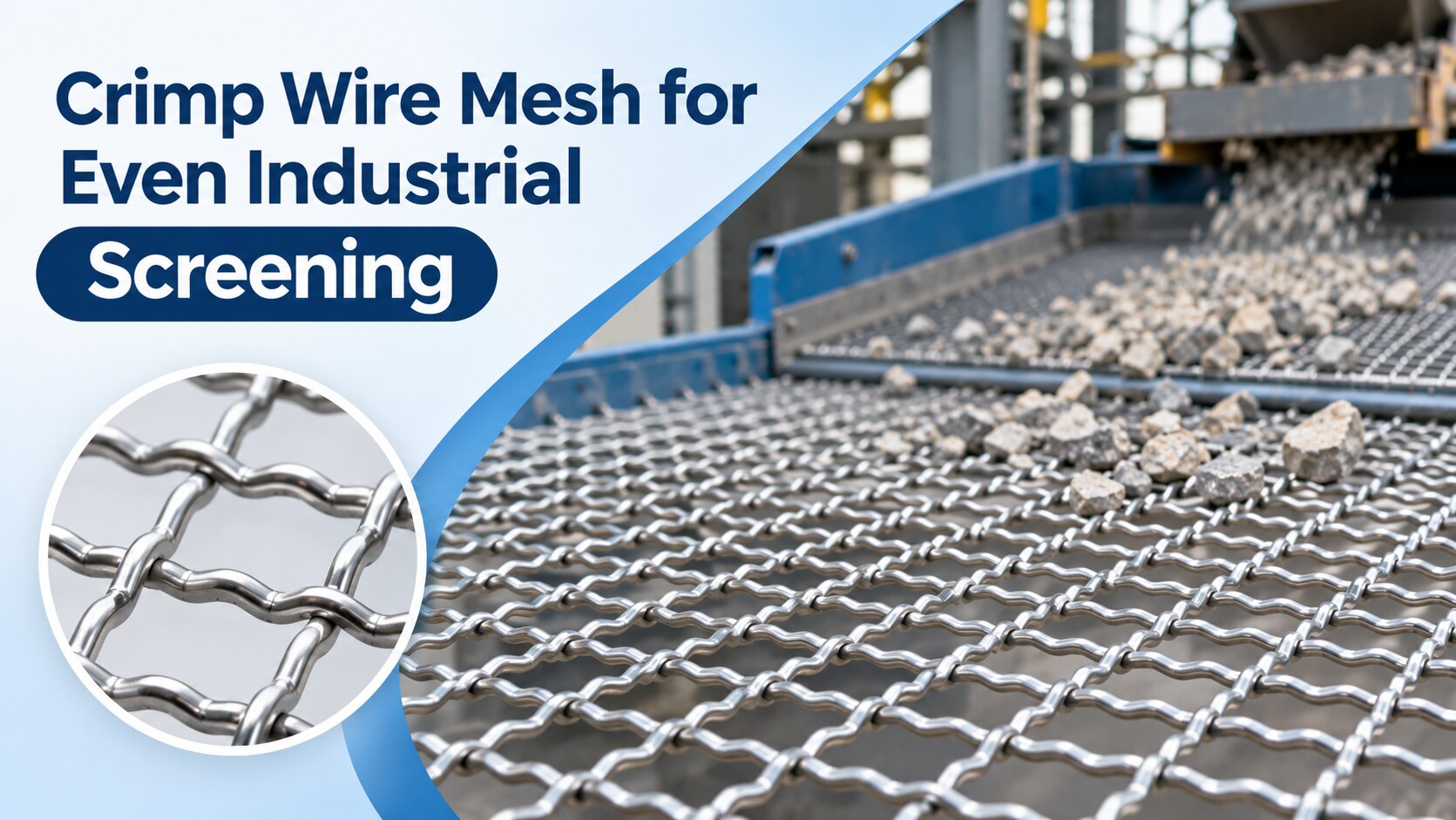
Uneven screening can come from distorted apertures, but it can also begin with a concentrated feed stream, excessive bed depth, poor vibration or a worn support system. By the end, you will be able to identify the source, select a crimped mesh design for the duty and specify or inspect a replacement without relying on nominal mesh size alone.
Key takeaways
- Check feed distribution, deck loading, blinding and vibration before changing mesh.
- Use crimping to help preserve consistent openings under impact and vibration.
- Specify opening, wire diameter and crimp style together for predictable screening.
- Measure clear openings and wire diameter on the replacement screen before approval.
Find the Source of Uneven Screening Before Changing the Mesh
Uneven screening is usually a distribution or operating fault, not proof that the mesh opening is wrong. A concentrated feed stream overloads one deck area, causing blinding and oversize carryover while the rest remains under-used.
A distributor, spreader plate, correctly positioned feed box, surge-hopper regulation, controlled feed rate or staged screening can outperform a replacement panel.
Cut size depends on moisture, residence time, bed depth, deck angle, particle shape and vibration, not only nominal aperture. Use this diagnosis before ordering industrial crimp wire mesh:
| Cause | What you see | Better first response |
|---|---|---|
| Variable particle size | Separation shifts with each batch | Regulate feed or add staged screening |
| Elongated or slabby feed | Particles bridge or travel over openings | Change orientation, aperture pattern or scalping |
| Uneven bed depth or concentrated feed | One zone blinds; another is empty | Fit a distributor or spreader plate |
| Wrong inclination | Material leaves before passing, or retention rises | Correct deck angle |
| Wrong vibration amplitude or frequency | Irregular flow and carryover | Check settings, drive and springs |
| Inadequate support spacing | Panel flexes under load | Add or reposition support bars |
| Stretched, torn or loose panel | Openings vary; edges flutter | Replace and correct clamping or tension |
Inspect feed distribution, support bars, clamps, panel tension and tears before testing a different opening. Wet cohesive feed may need anti-blinding measures or a different surface; crimping cannot cure overloaded capacity or faulty machine settings.
How Crimping Stabilises Openings Under Vibration and Impact
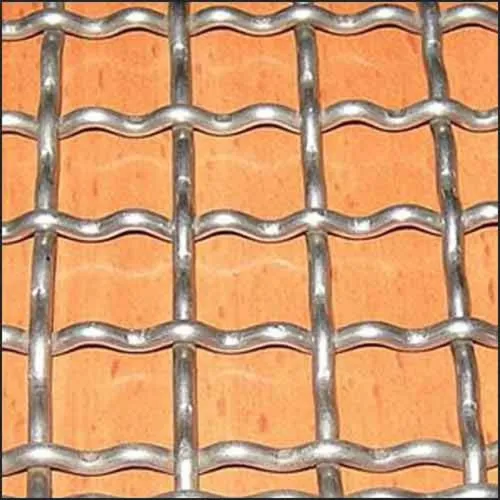
A loose plain weave can widen, narrow or skew at its intersections when vibration and impact flex the wires. Crimped wires are preformed, so they locate one another at each crossing and hold the clear opening more consistently.
Stable openings reduce oversize carryover caused by distorted gaps and make material flow more repeatable across the deck. They do not correct an aperture selected for the wrong cut size, an overloaded feed zone or incorrect vibration, speed or inclination settings.
Crimp style changes the compromise between opening stability, flow and wear:
| Option | Main advantage | Trade-off |
|---|---|---|
| Plain crimp | Good open area and general holding strength | Less aperture stability than lock crimp under severe impact |
| Intermediate or double/intermediate crimp | Balances open area, wear resistance and holding strength | More formed wire geometry can reduce free area |
| Lock crimp | Best aperture stability and strong wire location | Less open area and more difficult cleaning |
| Flat-top crimp | Smoother surface with less hang-up from sticky or irregular particles | Lower surface relief can reduce holding strength in some duties |
Install the panel with its wire orientation matched to the feed and machine motion. Check these mechanical details before blaming the mesh:
- Keep support-bar spacing within the panel’s design limit.
- Minimise unsupported spans that flex under the material bed.
- Check hooks, clamps and side edges for fatigue or distortion.
- Keep the panel tensioned and seated against every support.
Flexing changes the effective opening and accelerates failures at hooks or clamping edges. A concentrated feed stream can still blind one area while leaving another unused; a distributor or spreader plate may improve separation more than a new panel.
A buyer searching for crimp wire mesh for uneven screening in Aurangabad should compare these duty details, not location alone.
Choose the Opening, Wire and Crimp Style as One Screening System
A required cut size, not the largest particle in the feed, sets the clear aperture. Start with the target separation and particle-size distribution: near-size particles need enough opportunity to pass, while elongated or slabby pieces can bridge an opening or travel across the deck and cause apparent under-screening.
A smaller aperture improves separation but reduces throughput, increases blinding risk and keeps material on the deck longer.
| Option | Effect on screening | Use when |
|---|---|---|
| Smaller clear aperture | Finer cut, lower capacity and greater retention | The required cut is below the current separation |
| Larger wire diameter | Higher impact and abrasion resistance, lower open area | Abrasive or high-impact feed justifies reduced capacity |
| Lock or flat-top crimp | Lock crimp holds aperture; flat-top gives a smoother surface | Choose stability or reduced hang-up according to the feed |
Specify clear aperture and wire diameter together. For a square opening, estimate open area as (a/(a+d))² × 100, where a is the clear opening and d is wire diameter. Crimp geometry, pitch and wire profile change the actual result, so treat that figure as an estimate rather than a guarantee.
Choose high-carbon or abrasion-resistant steel for abrasive minerals. Choose stainless steel when corrosion, product contamination or temperature controls the decision; it is not automatically the longer-lasting abrasive option. A specification for industrial crimp wire mesh should include crimp style, material grade, panel dimensions and support-bar spacing, alongside moisture, temperature, duty and cut size.
Those details belong in a custom crimp wire mesh India request, not just a catalogue designation.
Specify and Measure a Replacement Screen Without Trusting Nominal Size
A replacement request is incomplete without the duty and the machine fit. Send a crimped screening mesh supplier the following measured information:
- Material grade; clear opening; wire diameter or gauge; crimp style; panel length and width; required cut size.
- Edge finish; fixing holes; hooks; side plates; clamp dimensions; support-bar spacing; screen orientation; machine make or model.
- Expected feed size and moisture; operating temperature; abrasion or corrosion exposure.
Measure at least five openings across the panel, including near both edges and the centre. Do not copy one central opening or a nominal mesh designation. Record wire diameter with calipers, then check panel flatness and squareness; compare hook, clamp and fixing dimensions before ordering.
| Finding | Likely meaning | Action |
|---|---|---|
| Every measured opening is wrong | Incorrect specification or aperture selection | Recalculate the required clear opening |
| Openings vary near edges | Stretched or loose edge, uneven tension or inadequate clamping | Inspect hooks, clamps and support |
| Wires are thin, intersections broken or tears visible | Operating wear or impact damage | Replace the panel and investigate feed conditions |
| A section flexes between supports | Excessive unsupported span or incorrect support-bar spacing | Correct the support arrangement |
Treat “crimp wire mesh in Aurangabad” as a sourcing term, not proof of suitability. Require dimensional inspection of representative openings, visual checks for broken or loose wires, and confirmation that the panel is flat and square.
Use ISO 9044 as a reference for industrial woven wire cloth test principles, then set your plant’s inspection interval from measured wear and failure history.
Turn Local Sourcing Into a Verified Screening Decision
A location keyword is not a performance specification. “crimp wire mesh in aurangabad” and “crimp wire mesh for uneven screening in Aurangabad” identify where to search, not whether a panel suits your feed, machine or overloaded deck area.
Send every supplier the same duty sheet and request written confirmation of:
- Clear opening, wire diameter or gauge, material grade and crimp style
- Open-area estimate, panel length and width, edge finish, hooks, holes and fixing details
- Support-bar spacing, expected feed size, moisture, temperature, abrasion or corrosion exposure and required cut size
- Dimensional inspection of representative openings, plus visual checks for broken or loose wires, panel squareness and flatness
Compare the quotation against the screening result you actually need:
| Nominal aperture | Effective cut size | What controls the result |
|---|---|---|
| Catalogue or specified opening | Separation achieved in operation | Particle shape, moisture, bed depth, deck angle, vibration amplitude and residence time |
A crimped screening mesh supplier should separate those two measurements. A quotation promising precise separation without process conditions is incomplete. Use ISO 9044 as a reference when defining woven-cloth inspection principles, but confirm the panel on your machine through a controlled trial.
For a custom crimp wire mesh India purchase, Laktas Wire Mesh Pvt.Ltd. Mr. Pramod K. is one potential India-based source for customized screening panels; judge the proposal by measured specifications, machine fit and trial performance, not by Aurangabad location alone.
Related products
 | ₹300 We are second largest wire mesh manufacturer and exporter in India. Crimp wire mesh made by pre-crimped wire and then weaved. View product → |
 | ₹180 With Commitment To Quality And Excellence, Specializing In Projects, We Work Closely With Our Customers To Meet Their Exact Requirements. View product → |
Frequently asked questions
What should you check before replacing mesh for uneven screening?
Inspect feed distribution, deck loading, blinding, oversize carryover and vibration. A concentrated feed stream can overload one area while leaving the rest of the deck under-used.
How does crimping help industrial screening under vibration?
Crimped wires interlock at their intersections, helping the screen retain its opening geometry when vibration, impact and material movement apply repeated loads.
Which specifications must you select together for crimp wire mesh?
Select the clear opening, wire diameter and crimp style as one system. Changing one affects open area, strength, wear resistance and screening behaviour.
How do you verify a replacement screen before installation?
Measure clear openings and wire diameter at multiple locations, then compare the results with the drawing or purchase specification instead of trusting nominal size alone.
Related products
 | Wire Mesh SS310 CRIMPED WIRE MESH Crimped Wire Mesh Laktas Wire Mesh's crimped wire mesh is a premium quality wire mesh product, expertly crafted to provide exceptional strength,... |
 | Wire Mesh MOC : GI OPENING : 13X 13 MM WIRE DIA : 3 MM SIZE : 1150 MM X 3000 MM View product → |