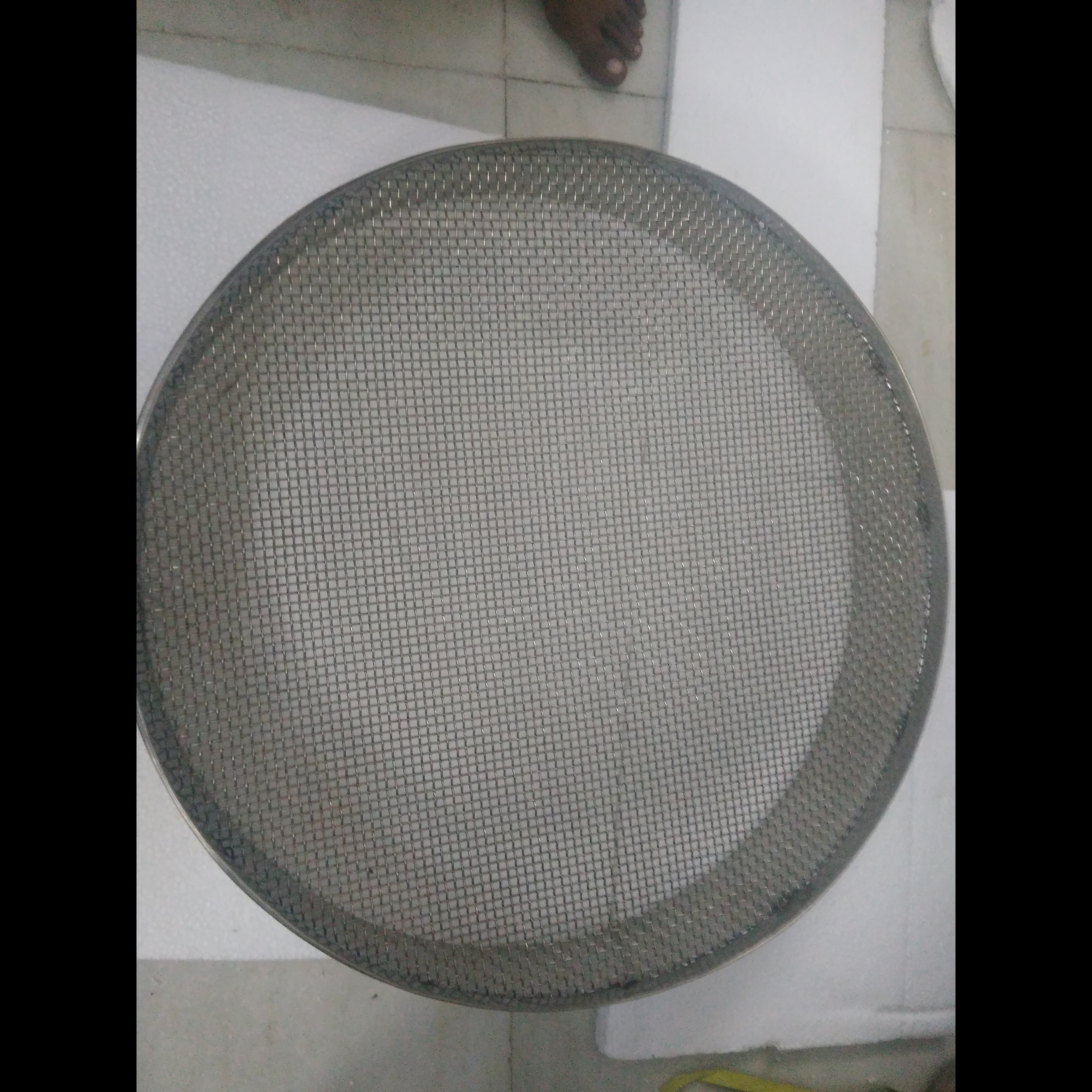
A test sieve is a precision laboratory instrument used to separate and classify material particles by size. It consists of a rigid frame (usually stainless steel or brass) that holds a finely calibrated woven wire mesh or perforated screen. Sieves are commonly used to generate particle size distribution curves for quality control.
Frame: A circular, rigid boundary that holds the mesh securely. Standard diameters typically range from 8 inches ((203, text{mm})) to 12 inches ((305, text{mm})) in the US, and (100, text{mm}) to (300, text{mm}) internationally.Screening Medium (Cloth): The woven wire mesh or perforated plate with exact, uniform aperture sizes.Skirt: The bottom edge of the frame designed to fit securely into another sieve or the collection pan.Pan: Placed at the very bottom of a sieve stack to collect fine particles that pass through all the screens
How They Work
Sieve Analysis: Multiple test sieves with decreasing mesh sizes are stacked on top of each other (coarsest at the top, finest at the bottom).Agitation: A material sample is placed in the top sieve and agitated (by hand or using a sieve shaker). Particles fall through the openings until they reach a mesh size too small to pass through.Measurement: The operator weighs the particles retained on each sieve to determine the particle size distribution.
CALL THIS NUMBER - 9820043743