
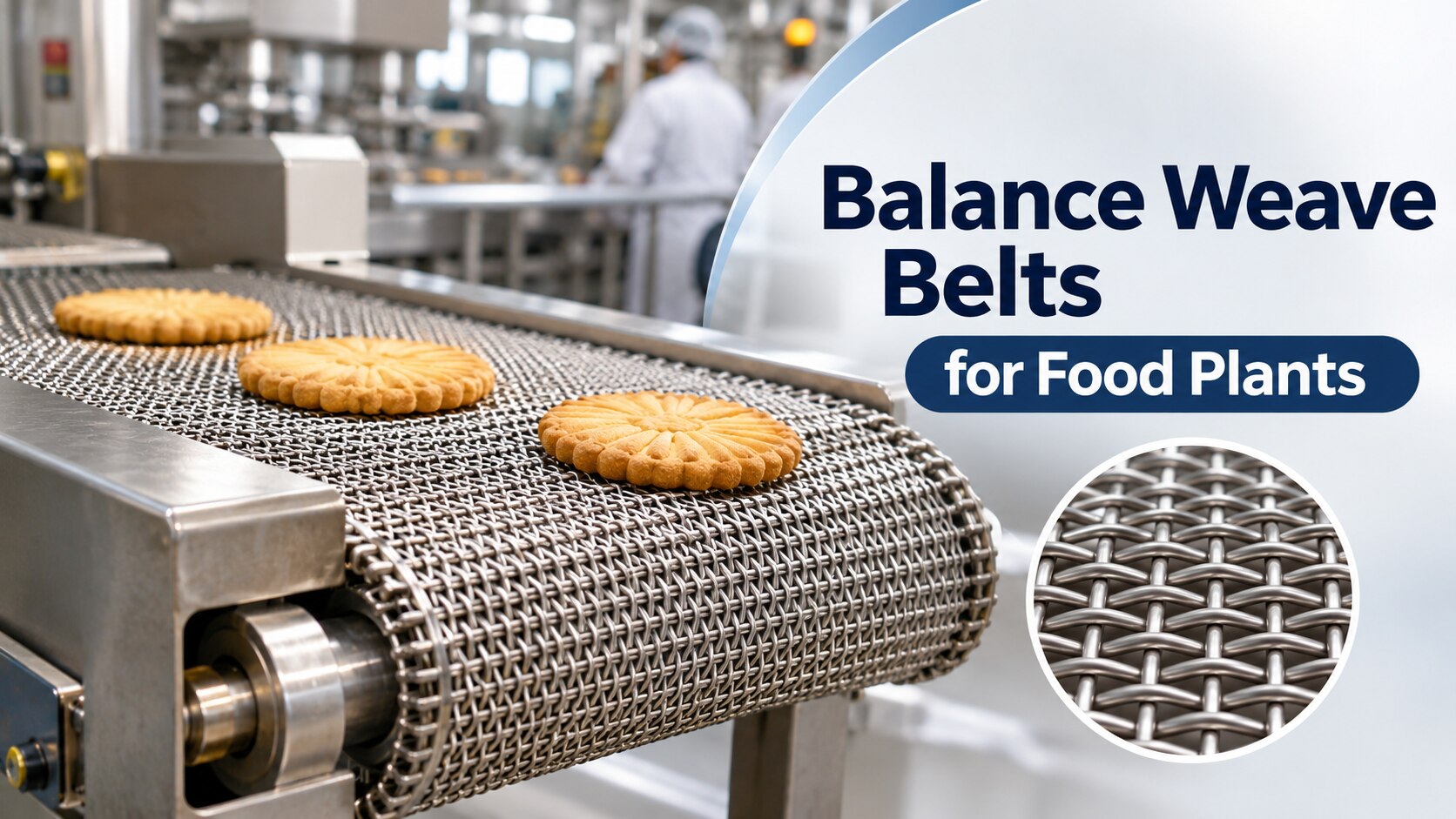
A food plant cannot order a balance weave belt by width alone: wire grade, spiral geometry, rod pitch, edge finish and drive dimensions determine whether it runs cleanly and tracks correctly. By the end, you will know how the belt is manufactured, how to specify it for your process and which checks to demand before installation.
Key takeaways
- Confirm wire grade, diameter, batch number and material certificate.
- Choose mesh geometry for product support, airflow and belt strength.
- Check belt width, length, sprocket pitch and conveyor tracking details.
- Specify temperature, cleaning chemicals, load and operating speed before requesting quotes.
How wire becomes a balance weave belt
The process starts with stainless-steel wire selected for grade, diameter, tensile strength and the plant’s temperature and cleaning conditions. The supplier records the heat or batch number before forming begins, so the finished belt can be traced to its material certificate.
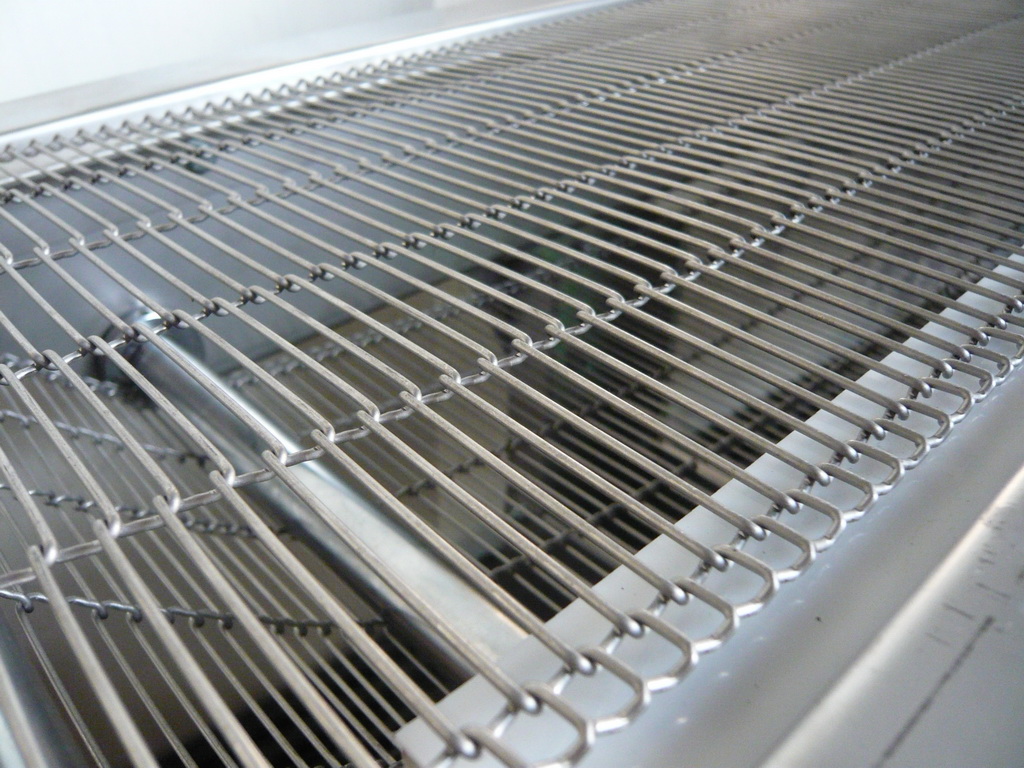
1. Form spiral wires. A machine coils the wire into right-hand and left-hand spirals with controlled pitch and aperture. Alternating the two directions balances lateral forces and helps the belt track more steadily than a single-spiral belt.
2. Insert transverse rods. Straight stainless-steel rods pass through the interlocking spiral loops at the specified spacing. Rod diameter and pitch determine load capacity, opening size and sprocket engagement.
3. Assemble and join the mesh. The spirals and rods are aligned across the required width, then the belt ends are connected with a joining rod or supplied as an endless assembly. Poor alignment here causes uneven tracking and premature wear.
4. Secure and finish the edges. Rod ends are welded, looped, or fitted with the specified edge treatment. The fabricator removes burrs, sharp projections and trapped wire ends that could retain food soil during washdown.
5. Set the width and inspect the belt. The assembly is cut or adjusted to its finished width, then checked for pitch, aperture, flatness, length, weld quality, edge condition and sprocket fit.
A balance weave belt manufacturer in Hyderabad should provide these measurements, material traceability and inspection records when you compare a locally made belt with an imported replacement.
How mesh geometry changes product support and belt strength
Ordinary balance weave suits most light-to-medium food conveying when the product needs open drainage and the belt needs to flex around a small nose bar. Choose compound balance weave when smaller apertures, greater load capacity or better support for small products matters more than maximum openness.
| Construction | Product support and strength | Choose it when |
|---|---|---|
| Ordinary balance weave | Open mesh, good airflow and drainage, moderate load capacity | You convey baked goods, vegetables or larger pieces at moderate temperature and speed |
| Compound balance weave | Tighter openings, more transverse rods and higher resistance to stretching and sagging | Small products could fall through, or heavy, hot loads demand a stiffer surface |
| Rod-reinforced balance weave | Added straight rods spread load and reduce belt deformation | Product weight is concentrated, or the belt spans long unsupported sections |
| Chain-edge or specialty construction | Stronger edge control and defined drive engagement, with less open area at the sides | The conveyor uses sprockets, high tension or difficult tracking conditions |
Do not choose by mesh opening alone. Match spiral-wire diameter, rod diameter, pitch, belt width, load, speed and operating temperature to the support arrangement and drive. An apparently correct balance weave conveyor belt in Hyderabad can climb or wear quickly if its sprocket pockets, rod pitch and shaft alignment do not match.
Inspect the edges and joints as carefully as the mesh. Burrs, protruding welds and trapped wire ends retain food soil; specify smooth weld finishing, accessible supports and an edge design compatible with washdown.
How stainless steel and hygiene requirements shape the build
Choose the stainless-steel grade from your cleaning chemistry, not from the label “food-grade.” AISI 304 suits most dry, wet and mild-detergent applications; AISI 316 or 316L is the safer choice where salt, brine, chloride-rich water, acidic residue or aggressive sanitisers remain on the belt. Chlorides can pit 304, leaving corrosion sites that trap soil.
| Grade | Best fit | Main caution |
|---|---|---|
| AISI 304 | General food conveying, baking, washing and packaging | Inspect for pitting after chloride exposure |
| AISI 316/316L | Salted products, brine, acidic foods and harsh washdown | Higher material cost; still needs thorough rinsing |
| Unknown grade | No defensible food-contact or corrosion decision | Reject until traceability and compliance evidence arrive |
Specify a smooth, cleanable surface rather than accepting “shiny” as a finish description. Ask for the supplied finish, measured roughness where critical, and passivation evidence after welding. Electropolishing suits high-hygiene lines with difficult soil removal; a sound 2B finish can suit many standard applications.
Rough welds, heat tint and deep scratches hold protein and detergent residue.
Edge construction must match both product handling and washdown access:
- Choose welded selvage edges when you need a continuous, snag-resistant boundary and frequent sanitation.
- Choose looped or clipped edges only after checking product catch points, scraper clearance and cleaning access.
- Require flush welds, no sharp projections, and inspection of every edge joint.
For any stainless steel conveyor belt India purchase, state the grade, finish, edge type, cleaning chemicals and food-contact market. Request material certificates and a food-contact declaration covering the intended food, temperature and cleaning conditions.
How to size the belt and verify conveyor compatibility
Measure the conveyor, not just the existing belt. Record usable belt width, frame clearance, shaft-to-shaft centre distance, take-up travel, belt travel direction, support-rail spacing, shaft diameter, keyway, sprocket pitch and sprocket count. Belt length must match the conveyor’s installed centre distance and adjustment range.
Before requesting a balance weave conveyor belt in Hyderabad, give the supplier this checklist:
- Product footprint, smallest opening it must cross, load per metre, belt speed and start-up load
- Operating temperature, heating or cooling cycle, washdown chemicals and cleaning temperature
- Required belt width, wire diameter, rod diameter, spiral pitch, aperture, thickness and edge construction
- Transfer gaps, incline or decline angle, tracking method and whether the belt runs over rails, rollers or a wear strip
- Existing sprocket tooth profile, pitch, bore, keyway and shaft alignment; include a drawing or clear photographs
- Required belt length, take-up allowance, splice method and spare-belt dimensions
Drive geometry determines whether the belt runs reliably:
| Drive arrangement | Measurements to confirm | Failure if mismatched |
|---|---|---|
| Sprocket drive | Rod pitch, sprocket pitch, tooth profile, shaft spacing and engagement depth | The belt climbs, skips, mistracks or wears at the rods |
| Drum drive | Drum diameter, belt thickness, wrap angle, tension and tracking system | The belt slips, stretches or damages its edges |
Check welds, rod ends and edges by hand before installation. Reject sharp projections, loose wire ends and crevices that can retain food soil.
What to put on a belt specification before requesting quotes
Give a Hyderabad supplier a drawing or mesh schedule, not the phrase “balance weave conveyor belt in Hyderabad.” Specify AISI 304 or 316/316L, wire and rod diameters, spiral and cross-rod pitch, aperture, belt width and length, edge construction, conveyor direction, sprocket details, operating temperature, product load, belt speed and cleaning chemicals.
Include these items in the request:
- Confirm whether the belt runs over sprockets or a drum, and attach shaft, sprocket and support dimensions.
- State whether food-contact documentation is required, identify the destination market, and describe salt, brine, chlorine or acidic washdown.
- Request replacement lead time, spare-belt availability and dimensional interchangeability with the installed belt.
A quote from a balance weave belt manufacturer in Hyderabad should be compared with an imported belt on installed suitability, not the label “stainless steel conveyor belt India.”
| Document | Ask the supplier for | Acceptance check |
|---|---|---|
| Material record | Grade, heat number and wire/rod test certificate | Grade matches the specification and remains traceable |
| Manufacturing record | Spiral pitch, rod pitch, weld method and edge-finishing details | Welds are sound; edges cannot snag product or operators |
| Final inspection report | Width, length, thickness, pitch, aperture, flatness and belt direction | Measurements fit the conveyor and sprockets |
| Compliance file | Food-contact declaration for the intended food, temperature and cleaners | Declaration covers your market and use conditions |
Laktas Wire Mesh Pvt.Ltd. Mr. Pramod K. is worth asking for the same drawing, traceability records and acceptance measurements before comparing its quotation with another food conveyor belt supplier in Hyderabad.
Related products
 | ₹1600 Metal Conveyor Belts By Laktas Wire Mesh, We Have Been The Leading Metal Conveyor Belt Manufacturer For Over A Century. View product → |
 | Our aim is your complete satisfaction with the performance of our products. View product → |
Frequently asked questions
How is a balance weave conveyor belt made?
A balance weave belt is formed by interlinking alternating right-hand and left-hand spiral wires with connecting rods, then assembling and finishing the belt to the required dimensions.
How does mesh geometry affect belt performance?
Spiral pitch, rod spacing, wire diameter and weave density determine product support, open area, airflow, load capacity and resistance to distortion.
Which stainless steel details matter for food-processing belts?
Specify the stainless-steel grade, wire diameter, tensile strength, heat or batch number, material certificate and resistance to the plant’s temperature and cleaning conditions.
What information should you provide when requesting belt quotes?
Provide belt width and length, wire diameter, spiral pitch, rod diameter and pitch, edge style, sprocket details, operating speed, load, temperature, cleaning chemicals and conveyor drawings.
Related products
 | ₹18000 Metal Conveyor Belt also know as wire conveyor belt or wire mesh conveyor belt.There are so many types based on different material ,Our wire mesh... View product → |
 | Honey comb conveyor belt ,Conveyor Belt ,Flat Belt ₹600 Metal Conveyor Belts By Laktas Wire Mesh, We Have Been The Leading Metal Conveyor Belt Manufacturer For Over A Century. View product → |
 | ₹35000 also know as wire conveyor belt or wire mesh conveyor belt.There are so many types based on different material ,Our wire mesh conveyor belts and... View product → |
 | conveyor belt ENROBER CONVEYOR BELT APPLICATION Snacks Industries , Meat Industries Fish Industries , Candy Industries Pizzas Industries , Small Potatoes... View product → |