A Pall Ring bed delivers useful gas-liquid contact only when its size, alloy, hydraulic capacity and distributor arrangement match the tower and process. By the end, you will be able to compare Pall Ring designs, select a defensible metal grade and verify that the quoted packing will fit and perform in your Kochi installation.
Key takeaways
- Use open Pall Ring geometry to improve gas-liquid contact and limit pressure drop.
- Match ring size to tower diameter, liquid load, gas velocity and fouling risk.
- Choose alloy by process chemistry, temperature, chloride exposure and cleaning method.
- Confirm dimensions, packing volume, inspection documents and installation access before delivery.
How Pall Rings create gas-liquid contact inside a tower
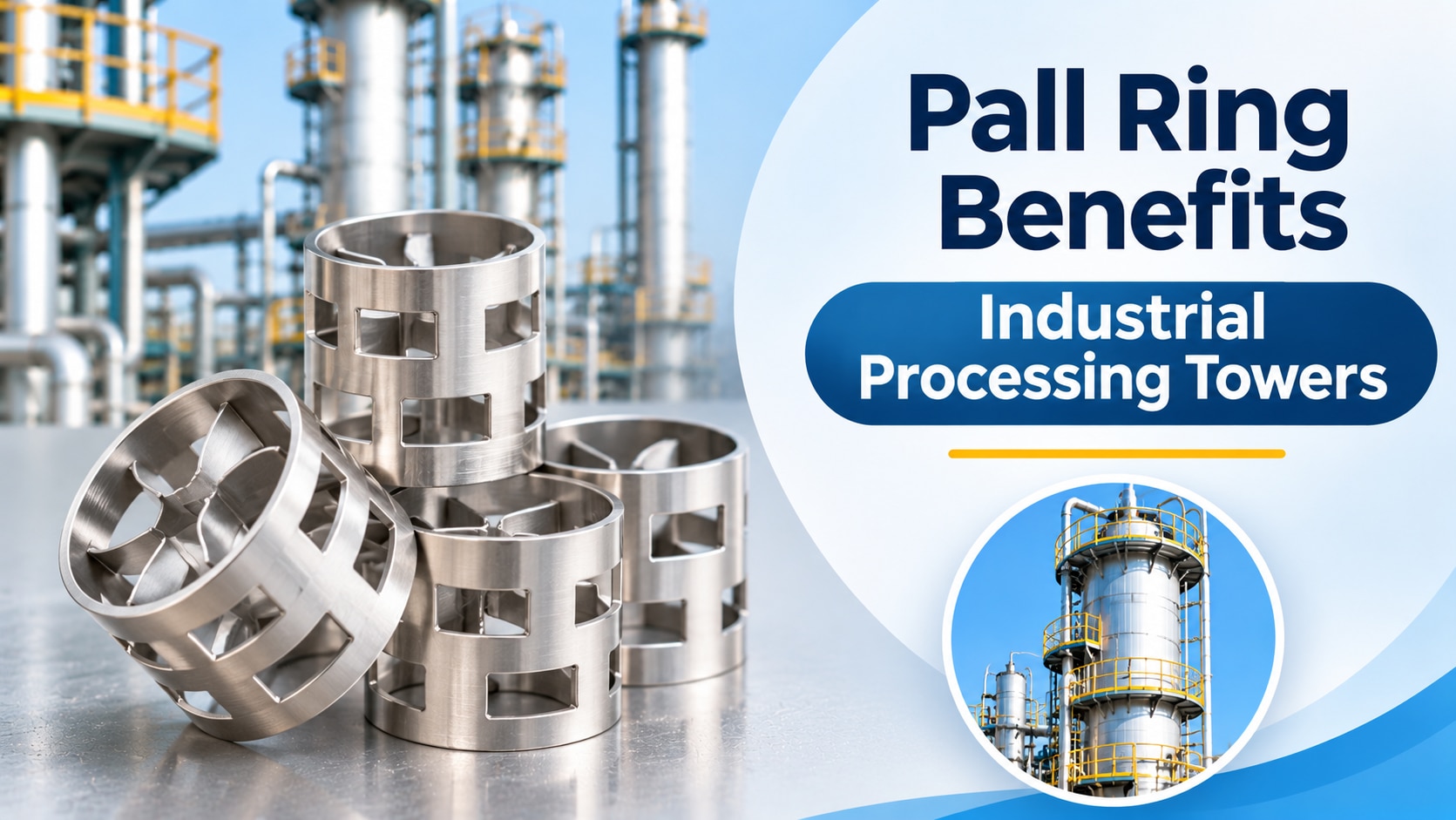
A Pall Ring tower packing improves gas-liquid contact by breaking the descending liquid into spreading films and droplets while leaving open paths for rising gas.
Its windows and inward-facing fingers interrupt the smooth cylindrical walls formed by conventional Raschig Rings, so liquid changes direction, wets more of the ring and meets gas across a larger active interface.
That interface enables mass transfer: an absorbed gas dissolves into the liquid, or a volatile component leaves the liquid for the gas. The open geometry reduces stagnant pockets and gives gas several routes through the bed, which lowers pressure drop and supports higher gas capacity than an equivalent conventional Raschig-ring bed.
It does not automatically outperform structured packing.
The advertised area is geometric, not guaranteed wetted area. Actual performance depends on:
- Liquid viscosity
- Surface tension
- Liquid-to-gas ratio
- Contamination
- Distance from loading or flooding
The distributor remains critical. A level distributor with clear orifices must wet the bed evenly; otherwise dry zones shrink effective area while channels let gas and liquid bypass one another. Smaller rings can provide more area but raise pressure drop and fouling risk. Larger rings ease flow and plugging but usually sacrifice contact area.
Which Pall Ring benefits matter most in Kochi towers?
There is no single best pall ring for industrial processing towers in kochi: the defensible choice depends on gas and liquid rates, tower diameter, pressure, temperature, viscosity, solids, corrosion chemistry, separation duty and allowable pressure drop. The main gains are usable capacity, wetted area and mechanical strength, not a universal performance advantage.
| Benefit | Why it helps | Trade-off or control |
|---|---|---|
| Lower pressure drop | Pall Ring openings limit resistance and increase flooding margin compared with conventional Raschig Rings | Smaller rings raise pressure drop; larger rings reduce area |
| Higher usable area | Windows and inward-facing fingers spread liquid and interrupt wall-like packing, improving mass transfer | Poor liquid distribution still creates dry zones and channeling |
| Liquid holdup | More retained liquid supports gas-liquid contact during operation | Excess holdup increases inventory and can slow drainage |
| Fouling resistance | Open geometry handles suspended material better than tightly packed shapes | Smaller rings still plug when solids loading is high |
| Mechanical durability | Metal rings tolerate higher temperatures, solvent loading and installation loads than plastic rings | They cost more and thin rings can deform if dropped from excessive height |
In Kochi, check both the process and the coastal environment. Chloride-bearing humidity can corrode packing during storage, while chloride concentration, pH, oxidizers, temperature and wet-dry cycling inside the tower determine alloy suitability; stainless steel does not guarantee immunity from pitting or crevice corrosion.
A correctly sized Pall Ring cannot rescue a poor distributor. Level the distributor, protect drip points from plugging and provide redistribution between deep beds. Then compare the calculated capacity and area against the required separation instead of accepting one standard size.
How to choose ring size, alloy and packing type
Pall ring selection starts with tower diameter, gas and liquid rates, pressure, temperature, viscosity, surface tension, solids and allowable pressure drop—not a default 75 x 75 mm size. Keep random-packing diameter at roughly one-eighth of tower diameter or less; oversized rings increase wall channeling and leave parts of the bed poorly wetted.
Specify these inputs before choosing:
- Vapour and liquid flow at minimum, normal and maximum load
- Operating pressure, temperature and required separation
- Chloride concentration, pH, oxidizers, solvents and wet-dry cycling
- Solids loading, fouling tendency and the tower’s liquid distributor pattern
For metal pall rings in Kochi, select an exact alloy grade, not “SS” or an unspecified “C S” designation. Confirm weld condition, sheet thickness, allowable temperature and corrosion guidance. Chloride-bearing coastal air affects storage, but process chloride, acidity and temperature usually control pitting and crevice corrosion.
Require clean handling, free-iron control and passivation or pickling where the grade and fabrication require it.
| Choice | Select when | Main risk |
|---|---|---|
| Smaller metal Pall Ring | Small tower or strong liquid distribution | Higher pressure drop and more difficult inspection |
| 75 x 75 mm ring | Large diameter, high-capacity bed supported by calculations | Channeling and poor wetting in a small vessel |
| Stainless steel | Process chemistry demands corrosion resistance | Pitting if chloride conditions exceed the grade |
| Carbon steel | Dry, non-corrosive service with a protected environment | Rapid corrosion during Kochi storage or operation |
| Plastic ring | Lower temperature and corrosion-sensitive service | Softening, crushing or solvent attack |
| Structured packing | Low pressure drop and predictable distribution are critical | Higher installation precision and cost |
What should you compare before choosing a tower-packing supplier?
Compare the packing’s operating fit, not just its advertised size. A standard metal Pall Ring is the right choice for a random-packed tower facing high temperature, solvent loading or rough installation, where mechanical strength, capacity and manageable pressure drop matter. It is not automatically superior in every service.
| Option | Choose it when | Main caution |
|---|---|---|
| Standard metal Pall Ring | You need a durable random bed at high temperature or high solvent loading | Corrosion, drop-in deformation and purchase cost |
| Raschig Ring | The service is simple and low-cost replacement is the priority | Lower usable capacity and poorer wetting |
| IMTP Ring | Pressure drop and mass-transfer efficiency are tightly constrained | Confirm hydraulic data; do not assume every IMTP design performs alike |
| Plastic packing | Corrosion resistance and low weight matter below the material’s temperature limit | Softening, crushing and solvent compatibility |
| Ceramic packing | Severe chemical attack and high temperature outweigh weight and brittleness | Breakage, dust and difficult handling |
| Structured packing | You need high efficiency at very low pressure drop in a clean, well-distributed service | Higher cost and greater sensitivity to poor liquid distribution |
Require an industrial tower packing supplier to provide:
- Dimensional drawing, nominal size, material grade, sheet or wire thickness, bulk density, void fraction, specific surface area and packing factor.
- Allowable temperature, corrosion guidance for chlorides, acids, alkalis and solvents, plus the test or calculation basis.
- Quantity basis: packed volume, theoretical count or shipping weight, with bulk-volume assumptions and expected deformation rate.
For a quotation from Laktas Wire Mesh Pvt.Ltd. Mr. Pramod K., use those figures to compare installed bed height rather than kilograms alone. Include gas and liquid rates, pressure, temperature, viscosity, surface tension, solids and allowable pressure drop.
Related products
 | ₹8 Manufacturer In Mumbai India. The Greatest Single Improvement In Random Packing Came With The Introduction Of “Windows” And “Fingers” To The Raschig... View product → |
 | ₹5 Traditional pall rings are simple rings with no internal strips mostly used as replacement tolls. View product → |
How to verify fit, quantity and installation readiness
Before ordering, match the Pall Ring selection to the tower’s measured internal diameter, distributor layout, support grid and required settled bed height—not just the nominal ring size.
1. Confirm the tower inside diameter at the packing elevation, shell out-of-roundness, support-beam spacing, access opening and available height below the liquid distributor. Check that the support plate, grid or ceramic saddle can carry the wet packing load and that its openings will not allow rings to fall through.
2. Give the supplier the gas and liquid rates, operating temperature, pressure, fluid composition, solids content and allowable pressure drop. Request the quoted packing factor, void fraction, bulk density, geometric surface area and bulk volume per tonne or cubic metre.
3. Calculate quantity from the required settled volume: tower cross-sectional area multiplied by target bed height. Reject a quotation stated only as theoretical count or shipping weight; two lots of nominally identical rings can produce different bed heights because of metal thickness, deformation and bulk density.
4. Check the liquid distributor’s level, drip-point density, orifice size, clearance above the bed and access for cleaning. Confirm redistributors for a deep bed, because poor distribution creates dry zones and channeling before the Pall Ring tower packing can perform.
5. Specify installation controls: maximum drop height, filling method, lot inspection and bed-height measurement after settling. Thin metal rings can distort when dumped from excessive height, reducing voidage and increasing pressure drop. Get an as-built drawing before release.
Frequently asked questions
How do Pall Rings create gas-liquid contact inside a tower?
Descending liquid spreads across the ring surfaces into films and droplets while rising gas moves through open passages. This increases contact area without blocking the gas path.
Which Pall Ring benefits matter most in Kochi towers?
Prioritise low pressure drop, reliable wetting, corrosion resistance and resistance to fouling. Kochi installations also need material selection that accounts for humid coastal air and chloride exposure.
How do you choose Pall Ring size, alloy and packing type?
Select ring size using tower diameter, gas velocity, liquid load, pressure-drop limits and fouling risk. Select the alloy from process chemicals, operating temperature, chloride exposure and cleaning conditions, then compare metal, plastic or ceramic packing where the process permits.
What should you compare before choosing a tower-packing supplier?
Compare exact ring dimensions, material grade, manufacturing consistency, nominal packing volume, inspection records, packaging and technical support. Ask how the supplier verifies quantity and protects packing during transport.
How do you verify fit, quantity and installation readiness?
Check the tower drawing, packing-support dimensions, distributor clearance, ring size and required volume before ordering. Confirm delivered quantity, batch or material documents, packaging condition and installation instructions before loading the tower.
Related product
 | ₹249334 Hsn Code 84199090 Moc- C S Pall Ring 75 X 75 X 1.5mm +/-0.1mm Thk Qty 1500 Kgs. Total Price 249334 3/4 Weeks From The Date Of Receipt Of Po. View product → |