
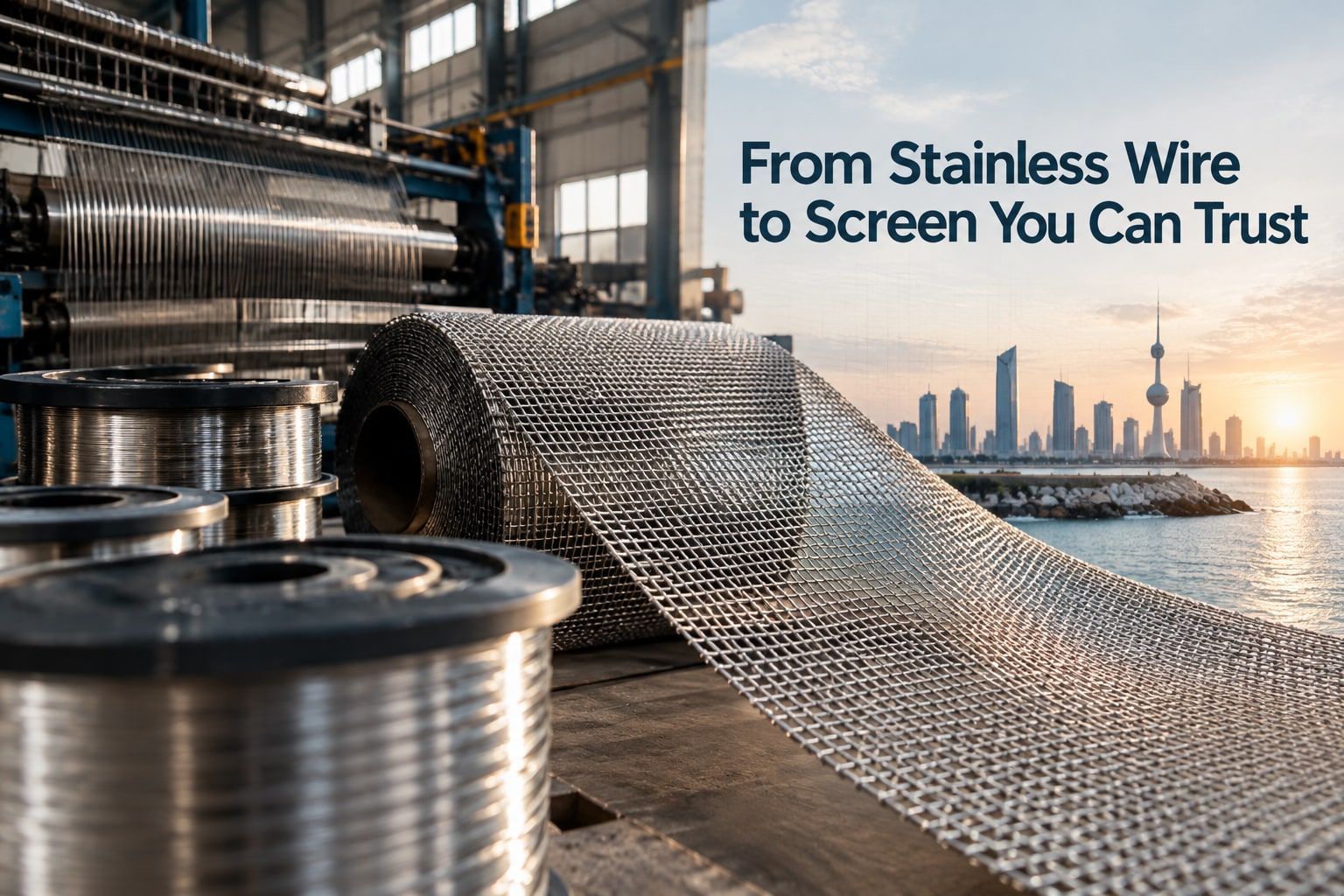
A finished stainless steel screen is the result of controlled material selection, wire drawing, heat treatment, weaving, inspection and conversion—not simply a stated mesh count. By following each production stage, you can distinguish woven cloth from welded mesh, select SS304 or SS316 for the exposure, and write a purchase specification that a Kuwait supplier can quote accurately.
Key takeaways
- Verify wire diameter before approving mesh openings.
- Choose SS316 for chloride exposure and coastal Kuwait service.
- Specify mesh count, wire diameter, grade and roll or sheet dimensions.
- Request heat numbers, inspection records and a sample opening check.
From Stainless Rod to Clean, Uniform Mesh Wire
An accurate mesh opening begins with wire whose diameter stays within a tight range. Stainless steel wire mesh production starts with certified stainless rod, commonly identified by grade and heat or batch number, then reduces it through progressively smaller dies until it reaches the drawing required for the screen.
The wire route controls four outcomes:
- Surface preparation removes scale, oil and embedded debris before drawing; poor cleaning leaves scratches or contamination that can become corrosion sites.
- Die reduction sets diameter and roundness. Worn or damaged dies create variation that changes aperture size across the finished cloth.
- Intermediate annealing restores ductility after heavy reduction. The final drawing pass then establishes the requested tensile condition, or temper.
- Final cleaning and spool preparation protect the surface and prevent kinks, crossed turns or tension changes during weaving.
Specify the wire by alloy, diameter, tolerance, temper and surface condition, not by mesh count alone. ASTM A580/A580M provides stainless steel wire requirements, but it does not define the finished woven construction, aperture tolerance or open area.
SS304 wire mesh manufacturing and SS316 mesh manufacturing follow this same drawing principle. Select the alloy for the exposure: chloride deposits, hot process conditions and chemical cleaning can make grade choice critical before weaving begins.
Where heat tint, iron transfer or shop contamination appears, pickling or passivation under ASTM A967/A967M can clean and restore the surface; it cannot correct an undersized wire or damaged finish.
How the Loom Turns Wire into Woven Cloth
The loom holds longitudinal warp wires under controlled tension while a shuttle or rapier carries each transverse weft wire across them. A reed then beats the new wire into position, repeating the interlacing pattern across the cloth. Tension, wire diameter and beat-up force determine whether the aperture stays uniform or drifts across the roll.
A loom interlaces wire; it does not resistance-weld crossing wires. That distinction matters in stainless steel wire mesh production because woven cloth suits filtration and precise screening, while welded mesh suits rigid panels, guards and partitions.
| Construction | How the wires interlock | Effect on the finished screen |
|---|---|---|
| Plain weave | Each weft wire passes alternately over and under successive warp wires | Square openings, even airflow and a straightforward general-purpose screen; fine cloth can sacrifice strength |
| Twill weave | Each wire passes over two or more wires before shifting the crossing | Greater wire stability and a smoother surface, with more flexibility for fine filtration than plain weave |
| Dutch weave | Finer wires and different warp and weft arrangements create narrow, non-square openings | High mechanical support and controlled particle retention; specify aperture or micron rating, not mesh count alone |
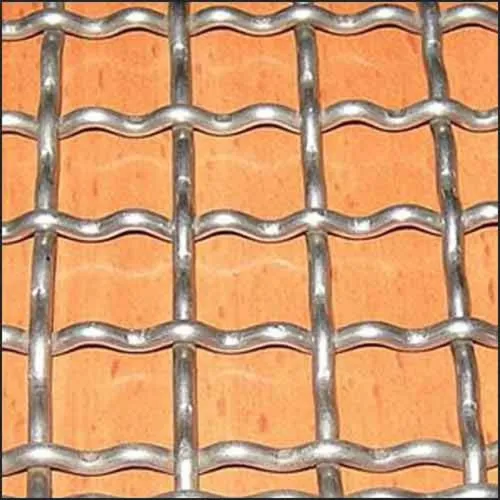
| Crimped weave | Wires are formed with bends before interlacing, so neighbouring wires lock together | A rigid, dimensionally stable screen with defined openings, useful for heavier screening loads |
For an industrial wire mesh Kuwait specification, identify the weave, wire diameter, aperture and open-area requirement. Calling every product “mesh” can lead to a welded panel, plain cloth or Dutch filter being priced against the wrong application.
Choosing SS304 or SS316 for Kuwait Service
SS304 provides adequate service for dry indoor screening, ordinary ventilation, and protected storage where chlorides and aggressive chemicals do not reach the cloth. It is the practical choice when the exposure is controlled and the cost of unnecessary alloying offers no useful life benefit.
| Grade | Suitable exposure | Main limitation |
|---|---|---|
| SS304 | Dry interiors, sheltered equipment, non-chloride process areas | Pitting risk rises with salt deposits, wet crevices, and chloride cleaners |
| SS316 | Seawater-adjacent equipment, desalination areas, coastal outdoor service, chloride-bearing chemicals | Higher resistance does not make it immune to pitting or crevice corrosion |
| Neither without review | Hot chloride service, persistent deposits, severe chemical exposure, or contaminated fabrication | Confirm the chemical, temperature, cleaning method, and surface condition before selection |
SS316 is justified when chloride concentration, wetness, temperature, or contamination creates a credible pitting risk. Deposits, stagnant water, narrow joints, weld discoloration, and iron contamination can shorten the life of either grade, so “marine grade” is not a service specification.
SS304 wire mesh manufacturing and SS316 mesh manufacturing follow the same drawing and weaving route; the alloy choice does not correct a poor finish or unsuitable design. Ask for the actual exposure conditions, not a label.
If you search for an “ss316 wire mesh supplier kuwait,” ask whether the cloth is locally woven, converted from imported cloth, or imported finished. Confirm grade, heat number, country of origin, and inspection documentation before treating the quoted material as equivalent.
How Manufacturers Define, Inspect and Finish the Screen
Acceptance starts with a drawing, not a roll label. In stainless steel wire mesh production, record grade, heat or batch number, wire diameter, mesh count, nominal aperture, weave, open-area percentage, width, length and edge condition. State every tolerance in millimetres or micrometres; mesh count alone cannot prove filtration because wire diameter changes the clear opening.
| Check | What to record | Why it matters |
|---|---|---|
| Material | SS304 or SS316, heat number, certificate and surface condition | Confirms alloy identity and traceability |
| Construction | Warp and weft count, wire diameter, weave and aperture | Proves the cloth matches the specified opening |
| Performance | Open-area percentage and aperture tolerance | Links the screen to airflow, pressure drop or screening capacity |
| Dimensions | Roll or sheet width, length, squareness and flatness | Prevents installation gaps and unusable trim |
| Workmanship | Broken or loose wires, blocked openings, stains, burrs and damaged edges | Reveals defects that can cause leakage or premature failure |
Use ISO 9044 for industrial woven-wire-cloth requirements and tests. ASTM E11 is aimed at test sieves and sieve cloth, while ASTM A580/A580M addresses stainless steel wire rather than the finished woven construction.
For an industrial wire mesh Kuwait order, require a dimensional inspection report tied to the lot, plus photographs of identification marks and packing. Confirm that measured apertures meet the drawing across the roll, not just at one sample point. A certificate without matching heat, batch and inspection records proves little.
What to Specify When Buying Stainless Mesh in Kuwait
Ask the supplier to put the complete supply route on the quotation. “Available in Kuwait” identifies stock location, not manufacture: an SS316 wire mesh supplier in Kuwait should state whether the cloth was woven locally, converted in Kuwait from imported roll stock, or imported as finished mesh.
Use this checklist for an industrial wire mesh Kuwait purchase:
- Construction: identify woven or resistance-welded mesh, plain, twill or Dutch weave, mesh count, wire diameter, nominal aperture, aperture tolerance, open-area percentage and dimensions in millimetres. Mesh count alone does not establish the opening.
- Material: state SS304 or SS316, wire temper and surface condition, with the manufacturer, heat or lot number and material test certificate. ASTM A580/A580M can support the stainless wire specification, but it does not define the finished woven cloth.
- Origin: request the country of origin, original mill or weaving manufacturer, production date and applicable inspection certificate. Ask how stainless steel wire mesh is made in Kuwait within that specific supply chain, rather than accepting a country label alone.
- Conversion: document who cut, slit, edged, framed or welded the cloth, plus finished length, width, squareness and joining method. Do not let a woven screen be substituted with welded mesh, perforated sheet or expanded metal.
- Packing: specify roll or panel format, core diameter, roll length, protective wrapping, moisture protection, labels and traceability markings.
- Suitability: provide chloride exposure, temperature, chemicals, cleaning method, filtration aperture, airflow or pressure-drop limit and operating load. Laktas Wire Mesh Pvt.Ltd. Mr. Pramod K. is one supplier a buyer can ask to record these details before approval.
Frequently asked questions
How is stainless steel wire mesh made in Kuwait?
Manufacturers draw certified stainless rod through progressively smaller dies, weave the wire on a loom, then inspect and finish the screen.
What is the difference between SS304 and SS316 wire mesh?
SS304 suits many general industrial applications, while SS316 provides better resistance to chlorides, salt air and chemical exposure because it contains molybdenum.
What should you specify when buying stainless steel mesh in Kuwait?
State the stainless grade, mesh count, wire diameter, opening size, weave pattern, sheet or roll dimensions, edge treatment and required inspection documents.
How do manufacturers inspect finished stainless steel wire mesh?
They check wire diameter, mesh count, opening size, weave condition, dimensions, surface defects and material traceability against the purchase specification.