
A roller chain selvedge is not selected by belt width alone: the chain, sprocket, mesh, load and operating temperature must work as one drive system. By the end, you will be able to compare selvedge designs, check sprocket compatibility and prepare a specification that a Mumbai supplier can quote and manufacture correctly.
Key takeaways
- Match the chain pitch and roller diameter to the conveyor sprocket.
- Use stainless steel for washdown and corrosion exposure.
- Specify chain type, belt width, rod spacing, and sprocket details.
- Send a dimensioned drawing to your Mumbai conveyor supplier.
What a roller chain selvedge does at the belt edge
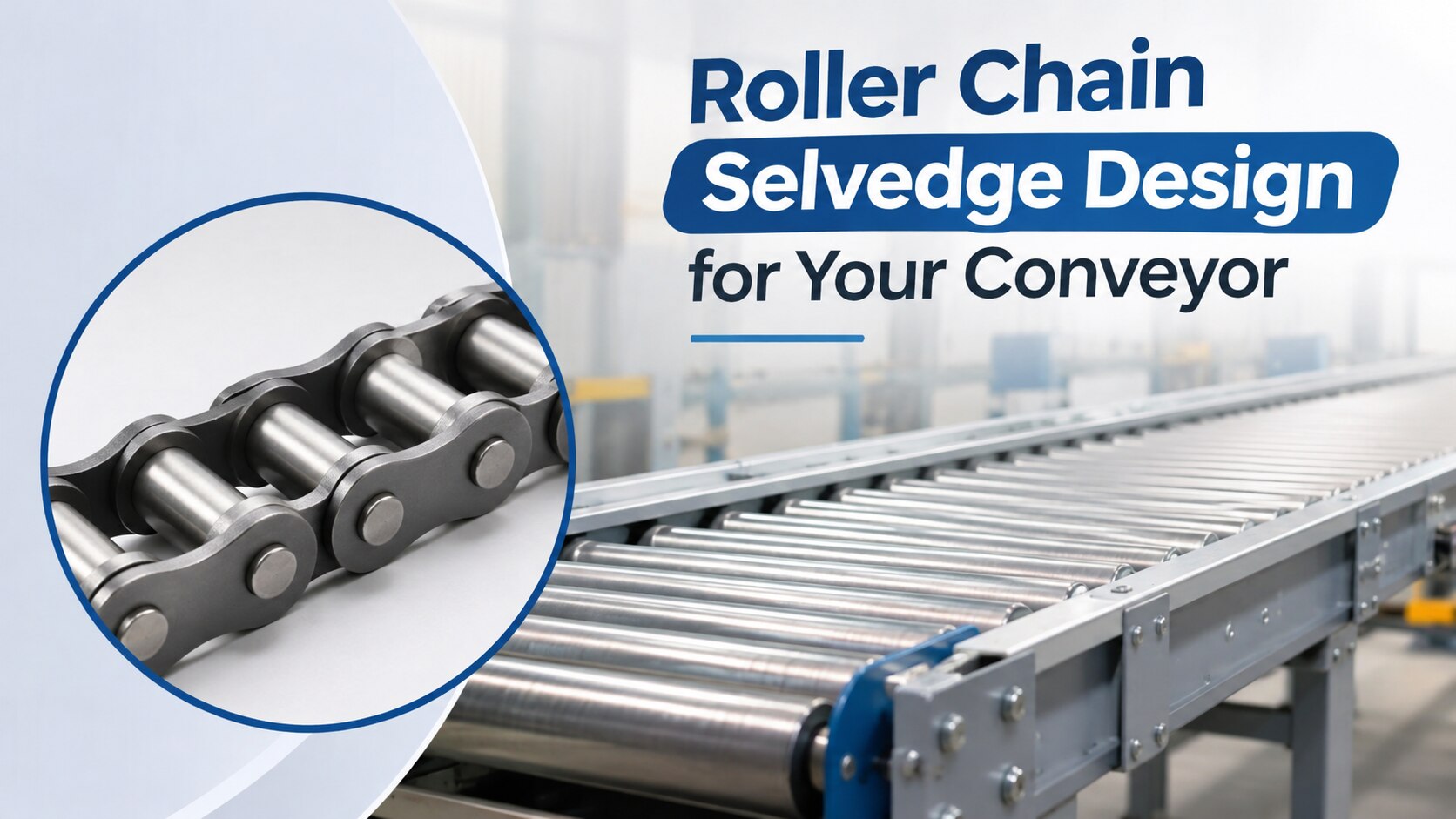
A roller chain selvedge is a side-edge chain assembly attached to the mesh belt. Cross rods pass through the mesh and connect to the chain plates, so the belt and both edge chains move together. Sprockets mounted on the conveyor drive shaft engage the chain rollers and transfer torque directly into the belt.
This positive engagement prevents the slip that a friction-driven edge can develop during indexing, incline conveying or heavy loading.
The main roller chain selvedge types are:
- Simplex: a single chain strand on each belt side.
- Duplex: two parallel chain strands for higher load or greater drive stability.
- Attachment: chain plates with extended pins or special tabs that retain the mesh or cross rods.
- Long-pitch or double-pitch: wider spacing between rollers for selected conveyor sprockets and product-handling layouts.
At the chain-to-mesh transition, check the open area rather than viewing the edge as a purely mechanical part. A denser strip can restrict airflow, drainage or small-product support in ovens, washers and filtration lines.
A chain edge conveyor belt still needs accurate alignment. Unequal chain length, mismatched sprocket phasing or a skewed shaft pulls the mesh sideways, bends rods and wears the edge. If the belt runs over drums without sprocket engagement, a formed-wire edge may be simpler than a chain selvedge.
Compare simplex, duplex, attachment and long-pitch chain edges
Choose the chain from the drive and load, not belt width: simplex suits compact, moderate-duty conveyors; duplex adds load capacity and edge stability; attachment chain simplifies belt fixing; long-pitch chain suits slow, lightly loaded runs.
| Option | Load and speed | Product-handling fit |
|---|---|---|
| Simplex or single-strand | Moderate tension and ordinary conveyor speeds; narrow edge and lower moving mass | Good for light or medium products when one chain provides enough support |
| Duplex or double-strand | Higher tension, wider belts and heavier loads; better resistance to edge twisting | Suits dense products, longer spans and belts that need two engagement lines |
| Attachment or extended-pin | Load depends on the base chain; pins or tabs create defined fixing points for rods and mesh | Useful when the belt needs positive rod retention, side guides or regularly spaced attachments |
| Long-pitch or double-pitch | Slow, relatively light duty; fewer sprocket engagements reduce chain cost | Works for stable products, but avoid frequent impact, high acceleration or close-pitch support needs |
Do not substitute one type because its nominal pitch looks similar. Roller diameter, inner width, plate profile, attachment dimensions and sprocket tooth form must match; long-pitch chain and its sprockets must be selected as one system.
For high-speed indexing or heavy incline loads, use the arrangement that gives reliable sprocket engagement without allowing the mesh to sag between supports. If sprocket drive is unnecessary, formed-wire, welded or rod-retained industrial conveyor belt edges can avoid chain weight, noise and cleaning traps.
A supplier should compare the complete chain-and-sprocket geometry, not quote from mesh designation alone.
Specify the chain and prove it matches the sprocket
A replacement chain edge is compatible only when its rollers, plates and attachments fit the existing sprocket—not when the belt width looks correct. For roller chain selvedge selection in Mumbai, record the drive arrangement before requesting a quotation:
- Chain pitch, roller diameter, inner width and plate height.
- Chain material and the number and spacing of edge chains.
- Belt width, mesh opening, cross-rod diameter and rod-end treatment.
- Attachment geometry, including extended pins, welded links or rod-retaining details.
- Sprocket tooth count, tooth profile, pitch diameter, bore, keyway and shaft arrangement.
- Sprocket spacing across the conveyor and the distance between sprocket centre lines.
| Check | Chain-edge measurement | Sprocket confirmation |
|---|---|---|
| Pitch | Measure centre-to-centre pin spacing | Match the sprocket tooth spacing |
| Roller fit | Record roller diameter and inner width | Confirm each tooth seats without binding |
| Drive layout | Specify edge-chain quantity and spacing | Match sprocket locations on the shaft |
| Attachments | Draw pin extensions and cross-rod joints | Check clearance from teeth, plates and guards |
Do not approve a chain edge conveyor belt from nominal pitch alone. Duplex, attachment and long-pitch chains can share similar pitch descriptions while differing in roller diameter, plate profile and attachment dimensions.
Ask for a drawing that shows the sprocket profile, edge-to-edge width, weld locations, joining method and replacement splice procedure. Check the mesh-to-chain transition: a denser side strip can alter airflow, drainage and support for small products.
Choose materials and sizing for heat, washdown and heavy duty
Choose the selvedge material and chain size from the hottest, wettest and most heavily loaded operating condition—not belt width. State the operating temperature, belt length, product load, conveyor speed, incline, allowable chain tension and take-up travel.
Calculate thermal growth across the full belt length; a belt sized at room temperature can become tight in a hot zone and overload its sprockets.
| Option | Material and sizing decision | When it fits |
|---|---|---|
| 304 stainless chain | Good corrosion resistance; size for calculated pull and torque | Baking, drying and ordinary washdown |
| 316 stainless chain | Better resistance to chlorides and caustic washdown; check strength against the required load | Food, chemical and salt-exposed washers |
| Carbon-steel chain | Higher wear resistance at lower cost; protect it from water and select a larger pitch or duplex edge when pull rises | Dry, heavy-duty conveying |
Drive torque determines whether a simplex edge is sufficient or whether a duplex or attachment chain is needed. Divide torque by the effective sprocket radius to estimate chain pull, then compare that pull with the chain’s allowable working tension—not its breaking load. Shock loading, starts under load and an inclined conveyor require additional capacity.
During roller chain selvedge selection in Mumbai, specify the chain pitch, roller diameter, inner width, cross-rod diameter and sprocket tooth count. Check the mesh-to-chain transition: industrial conveyor belt edges can restrict airflow, drainage or small-product support, especially in ovens and washers. Also state the take-up arrangement and replacement splice method.
Give a Mumbai supplier a drawing, not only a belt width
Send a dimensioned belt drawing with your quotation request; belt width alone cannot produce an interchangeable roller-chain edge. Your roller chain selvedge selection in Mumbai must begin with the conveyor’s drive arrangement, process conditions and existing sprocket geometry.
Include these details:
- Finished belt width, overall edge-to-edge width, usable mesh width and belt length
- Chain standard or chain drawing, including pitch, roller diameter, inner width, plate height and material
- Number of edge chains, their spacing, and whether the construction is simplex, duplex, attachment or long-pitch
- Cross-rod diameter, rod spacing, rod-end treatment, weld locations and the belt joining method
- Sprocket tooth count, pitch profile, roller clearance, sprocket spacing, shaft diameter, shaft arrangement and rotation direction
- Product load, conveyor speed, incline, operating temperature, washdown chemicals and cleaning method
- Required belt material, mesh designation, replacement splice procedure and any turning or transfer section
- Drawing number, revision, belt identification mark and requested inspection or material records
Ask the conveyor selvedge supplier in Mumbai to return a marked-up drawing showing every chain and sprocket interface. State whether ISO 606 applies; if the edge uses conveyor chain geometry, require the chain drawing instead of accepting “roller chain” as a complete specification.
Give Laktas Wire Mesh Pvt.Ltd. Mr. Pramod K. the existing belt drawing and a sprocket photograph with measured dimensions, not a catalogue description. That evidence exposes mismatches before fabrication.
Frequently asked questions
What does a roller chain selvedge do at a conveyor belt edge?
It connects the mesh belt to the drive system. Cross rods pass through the mesh and attach to both chain edges, while sprockets engage the chain rollers to move the belt.
How do simplex, duplex, attachment, and long-pitch chain edges differ?
Simplex uses one chain strand, duplex uses two parallel strands, attachment chains provide fixing points for the belt, and long-pitch chains use greater spacing between pins. Select the design that matches the load, belt construction, and sprocket.
How do you prove a chain edge matches the sprocket?
Compare the chain pitch, roller diameter, inner width, plate height, and attachment geometry with the sprocket drawing. Confirm the sprocket tooth form and number of teeth before ordering.
Which chain edge material suits heat and washdown service?
Use stainless steel where water, detergents, or corrosion are present. Select a heat-rated alloy and suitable lubrication plan for high-temperature service, then verify the chain manufacturer's operating limits.
What should you send a Mumbai conveyor supplier besides belt width?
Provide a dimensioned drawing showing chain type, pitch, roller diameter, belt width, rod diameter, rod spacing, mesh specification, edge attachment, sprocket details, operating temperature, washdown chemicals, and load.