
A Nashik perforated-sheet order succeeds or fails before the press starts: the drawing must define the hole, pitch, pattern direction, border, steel grade, finish and finished size. By following the production route and checking the right measurements, you can approve a design that fits the application, limits scrap and arrives ready for installation.
Key takeaways
- Start production from an approved drawing, not a sheet-thickness request.
- Match hole pitch and open area to airflow, screening and structural needs.
- Check levelling, burr removal, dimensions and surface finish before dispatch.
- Confirm material documents, packing and delivery access for the Nashik site.
From approved drawing to prepared mild-steel sheet
A Nashik order starts with an approved drawing, not with a generic request for “3 mm MS perforated sheet.” MS perforated sheet manufacturing follows the same perforation technology used elsewhere in India; Nashik affects local sourcing, production scheduling and freight to the delivery location.
1. Review the drawing for the application, steel grade and material standard; hot-rolled steel suits heavier structural screens, while cold-rolled steel suits cleaner surfaces and tighter gauge control. Confirm nominal thickness, sheet or coil route, finished length and width, quantity, tolerances, coating, packing and delivery point.
2. Define the opening precisely: hole shape, hole diameter, centre-to-centre pitch, pattern direction, open-area requirement, blank borders and cut-edge condition. Label “3 mm hole diameter” explicitly; 3 mm must not be assumed to mean pitch.
The plant checks the layout against the stock sheet, trimming allowance, first and last hole rows, and required borders so the pattern does not leave unusable edge strips.
3. Choose the production route. Punching individual plates suits fixed panel sizes, heavy gauges, short runs and controlled borders. Perforating coil suits repeatable patterns and production quantities, with the strip later levelled and cut into sheets.
4. Select the tool after checking thickness, hole-to-thickness ratio and quantity. A shaped punch-and-die set is economical for repeated standard patterns; laser cutting is better for prototypes, irregular patterns, large holes or low quantities where new tooling would cost more. Incoming sheet or coil is then identified, surface-checked and prepared for alignment.
How holes are punched, levelled and finished
A hole much smaller than the sheet thickness raises punching force, tool wear and the risk of distorted or partly formed holes. The exact limit depends on steel grade, punch clearance, press capacity and tool condition.
1. Incoming sheets or coils are checked for scratches, rust, dents, thickness and heat or batch identification. Operators align and level the material, then load the programmed hole layout or mark the reference edge, pitch and pattern direction.
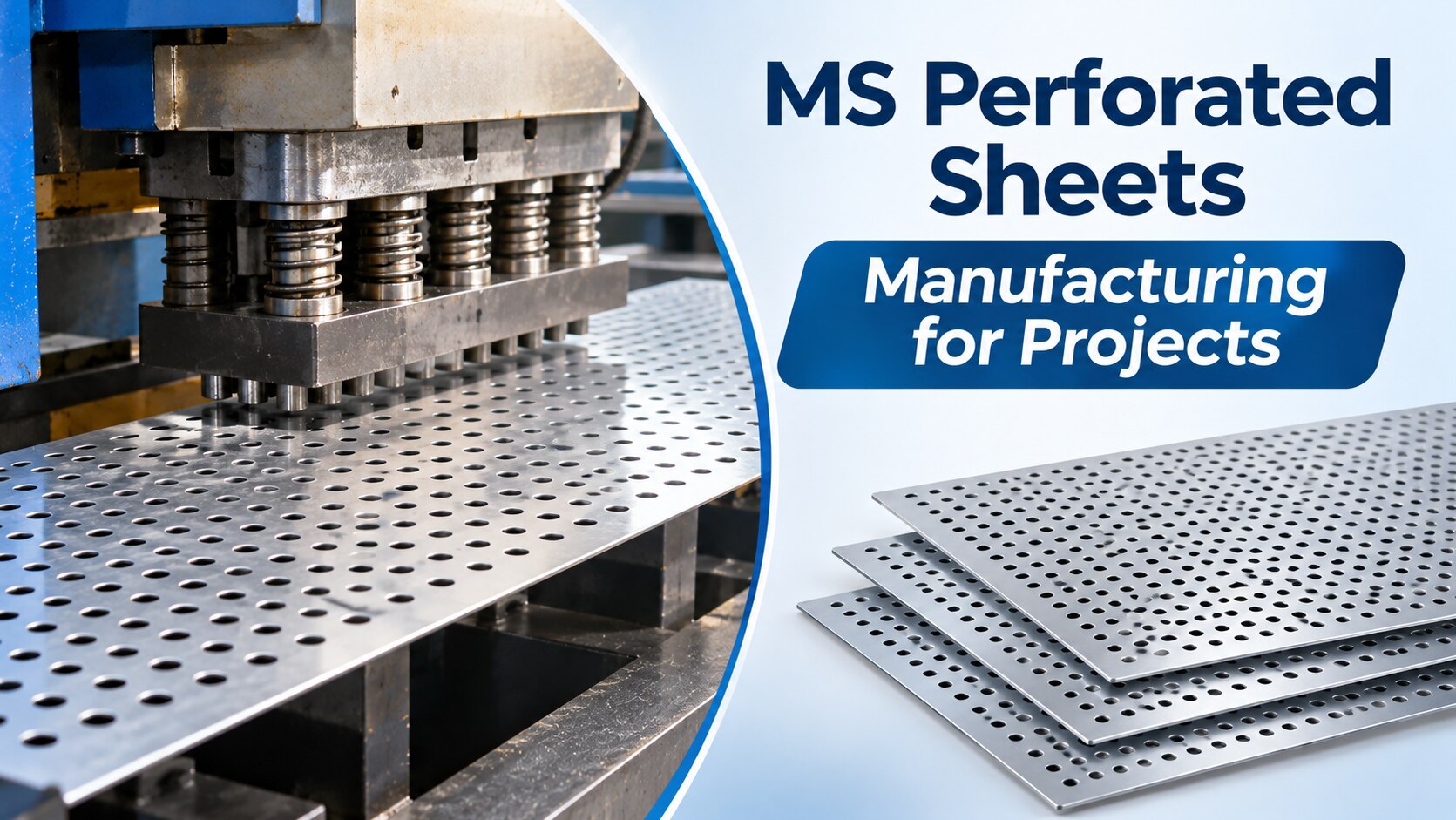
2. The press advances the sheet, the punch enters the die and each stroke removes a slug. A collection system must clear slugs immediately; slug pulling, stacking or re-striking creates double-hit holes, raised marks, torn ligaments and damaged tools.
3. Punch-and-die clearance controls punching force, burr direction and hole shape. Excessive clearance leaves a large fractured edge; insufficient clearance increases force and tool wear. Stripper pressure must hold the sheet without marking it, while hardness, thickness and worn punches affect dimensional accuracy.
4. Perforation can bow, dish or wrinkle the sheet. Roller levelling or stretcher levelling restores flatness when specified, but excessive force can enlarge holes, mark the face or change local flatness. The sheet is then trimmed to finished size and checked against the agreed flatness limit.
5. Deburring uses one-sided or two-sided brushing, tumbling, edge dressing or another specified method. Bare sheet needs rust protection: oil suits short storage, while primer and paint, powder coating or galvanizing suits longer service. Coating exposed hole edges and interiors changes final dimensions and adds curing or processing time before delivery.
Choosing pitch, open area and panel geometry
Choose the pattern by function: airflow and acoustic panels need predictable open area, screening needs controlled passage size, while guarding and architectural cladding also need stiffness and appearance. Hole diameter is the opening size; pitch is the centre-to-centre distance between holes.
Ligament width is pitch minus hole diameter, while a margin is the solid distance to the sheet edge and a blank border is a deliberately unperforated zone.
| Pattern | Advantage | Typical use |
|---|---|---|
| 60-degree triangular or staggered | High opening efficiency and uniform distribution | Airflow, screening and acoustic panels |
| Straight-line | Aligned rows simplify visual orientation | Architectural cladding and guarding |
| Square | Clear grid and easier edge alignment | Panels with bolt holes or defined borders |
For round holes on a 60-degree staggered layout, open area (%) ≈ 90.69 × d² ÷ C², with d and C in the same units.
A 3 mm hole at 6 mm pitch gives about 22.7% open area; increasing pitch to 9 mm reduces it to about 10.1% and widens the ligament from 3 mm to 6 mm. Reducing pitch increases airflow or screening area but weakens the panel and increases punching density.
Do not size stiffness from open area alone. Thickness, hole shape, pattern direction, border size and ligament width affect buckling and load capacity.
For perforated sheet production in Nashik, state these on the drawing:
- First and last hole-row position, edge margins, blank border and bend lines
- Bolt-hole locations, cut size, pattern direction and required open-area tolerance
- Available sheet dimensions, trimming allowance and grain direction
Check nesting before approval: unusable edge strips can make a cheap pattern expensive.
Inspection, documents and delivery to a Nashik site
1. Inspect the punched panels against the approved drawing before packing: steel grade, actual thickness, hole diameter, centre-to-centre pitch, open area, pattern orientation, sheet length and width, border size, cut-edge condition, burrs, flatness and coating condition.
2. Use the agreed drawing, material standard or inspection report for thickness, hole-diameter, pitch, flatness and cut-size tolerances. Do not substitute an assumed industry value; an unrecorded tolerance can turn a correctly priced sheet into a failed installation.
3. Request the material test certificate where specified, dimensional inspection report, coating or galvanizing record when applicable, packing list, invoice and dispatch details. Check that the listed 1,250 mm × 2,500 mm stock size suits the finished panel, transport route, doorway, lift and installation frame.
4. Confirm the delivered cost beyond the sheet rate. Nesting waste, special tooling, setup, minimum quantity, deburring, cutting, finishing, freight and GST can each change the quotation.
5. Pack panels with clean spacers between faces and stack them on a level base. Lift them without gripping unsupported edges, and protect bare or coated MS from rain and condensation; trapped moisture starts corrosion before installation.
6. Keep paint, dust and packaging film out of the holes. At site, remove protection only after the panels are indoors and dry, then check the frame, bolt-hole alignment and border before fixing. Do not force a warped panel into position, because that can enlarge holes, damage coating and transfer stress to the frame.
Selecting the right Nashik supply route and material
Choose the supply route before ordering: perforated sheet suits regular holes, predictable open area and clean panel geometry, but another mesh or cutting method may fit your application better.
| Option | Best fit | Main trade-off |
|---|---|---|
| Perforated sheet | Regular openings, panels and guards | Tooling limits nonstandard patterns |
| Expanded metal | Continuous mesh with low scrap | Less precise hole geometry |
| Welded mesh | Intersecting wires, fencing and reinforcement | Openings and wire joints limit appearance |
| Woven wire mesh | Fine filtration | Less rigid for large panels |
| Laser-cut plate | Prototypes, irregular profiles and unusual openings | Higher processing cost for repeat production |
Mild steel is the wrong starting material for wet or corrosive service, food-contact equipment, frequent washdown or high-temperature exposure. Specify stainless steel or another alloy when rust, contamination or heat would invalidate the panel; paint or galvanizing is not a substitute for the required base material in every service.
Use this quotation procedure:
- Send the grade, thickness, sheet or coil preference, hole shape and size, pitch, pattern direction, margins, open area, quantity, cut size, finish, tolerances, drawing and Nashik delivery point.
- Ask for an approved sample, tooling confirmation, inspection documents, finishing capability, packing method and a complete delivered-cost breakup covering setup, cutting, coating, freight and taxes.
Laktas Wire Mesh Pvt.Ltd. Mr. Pramod K. can be compared with any MS perforated sheet supplier by checking those records and capabilities, not the nominal sheet rate alone.
Related products
 | ₹18880 Hsn Code 7220 2 Thk X 3 Mm Hole X 6mm triangular Pitch Size:- 1250 Mm X 2500 Mm Qty 5 Pcs Total 18880 Ready Stock 100% Against Performa Invoice P&F +... View product → |
 | Laktas Wire Mesh Pvt Ltd Is One Of The Leading Manufacturing Companies In Asia . View product → |
Frequently asked questions
How are MS perforated sheets made for a Nashik project?
The process begins with an approved drawing and prepared mild-steel sheet, followed by punching, levelling, finishing, inspection and delivery planning.
How should you choose hole pitch and open area?
Choose pitch and open area based on airflow, screening performance, strength, noise, cleaning access and the panel’s supporting frame.
What should you inspect before MS perforated sheets are delivered?
Check sheet thickness, hole size and spacing, panel dimensions, flatness, burrs, surface finish, quantity and the accompanying material documents.
How do you select a Nashik supply route and material?
Compare local production, imported material and interstate supply by material grade, capacity, lead time, documentation, transport risk and site access.
Related product
 | ₹500 Laktas Specialise In Perforated Metals And Expanded Metal For A Variety Of Applications In The Architectural And Engineering Sectors. View product → |