
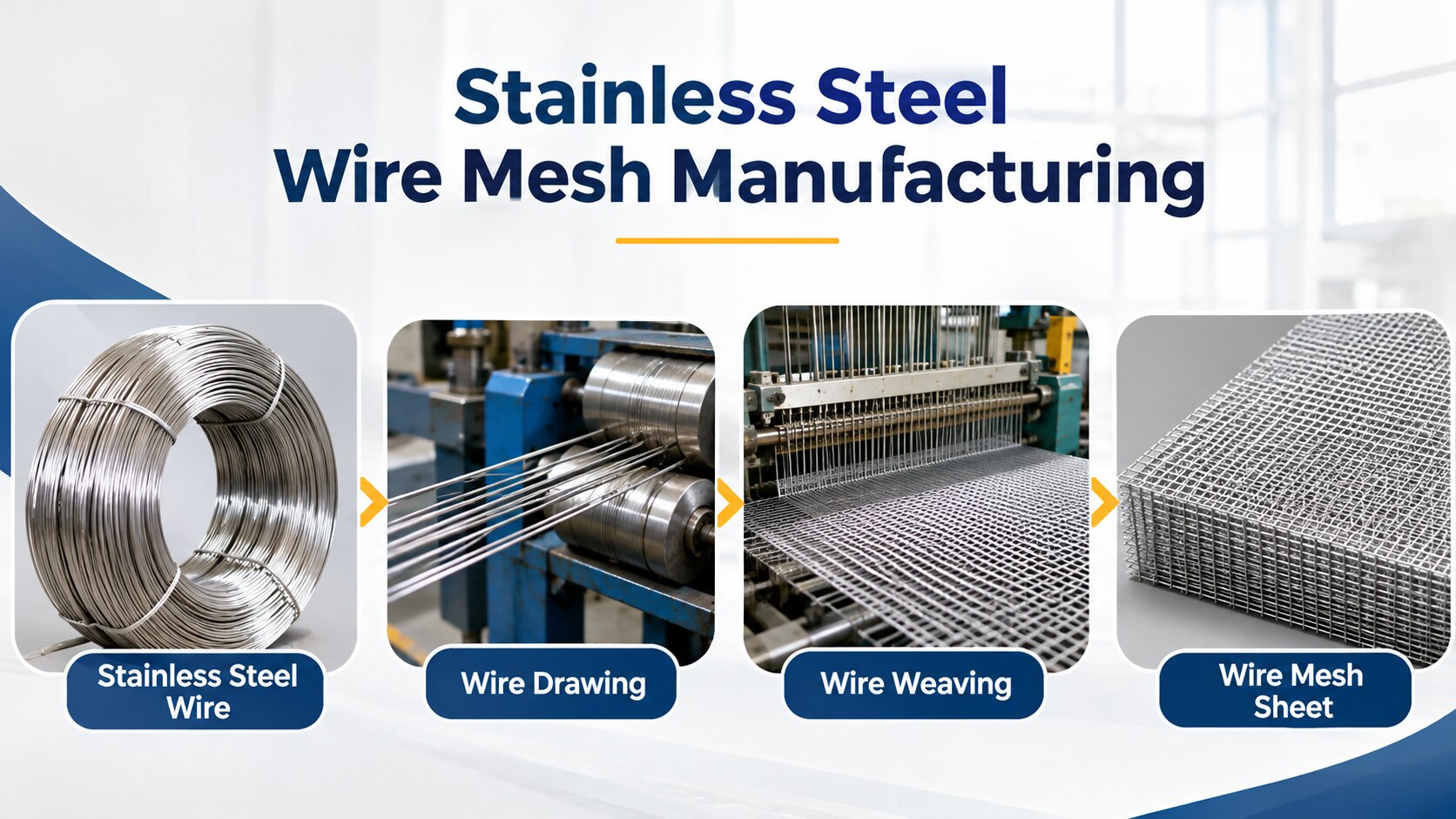
A stainless steel mesh sheet is the result of controlled wire diameter, heat treatment, surface preparation, forming, conversion and inspection—not simply a wire-cloth label. By following each production stage, you can compare SS 304 and SS 316, specify the opening and edge condition correctly, and check whether the finished sheet suits your process.
Key takeaways
- Specify mesh count, wire diameter, and aperture as one matched set.
- Ask for material grade, test certificates, and dimensional inspection records.
- Choose woven mesh for precise openings and welded mesh for rigid grids.
- Check aperture, sheet size, cleanliness, and edge condition before approval.
How stainless steel rod becomes weaving wire
SS 304 wire mesh production starts with stainless steel rod, not finished wire. The rod is hot-rolled, descaled to remove surface oxides, then reduced through a sequence of dies. Each drawing pass decreases diameter and increases work hardening, so the schedule controls diameter tolerance, tensile strength, surface finish and ductility.
1. Select the grade for the service. SS 304 is the common general-purpose austenitic chromium-nickel grade, valued for corrosion resistance and formability. SS 316 adds molybdenum and suits chloride, salt and some chemical exposures better; it is not immune to chloride attack.
2. Draw the rod through progressively smaller dies. Anneal between drawing stages when the accumulated cold work makes the wire too hard or brittle. The final pass establishes the nominal diameter needed for the warp and weft wires.
3. Remove processing residue before winding. Degreasing takes off drawing lubricant and rolling oil; pickling removes heat-tint oxides and scale; passivation restores a chromium-rich passive surface. These are separate treatments, not automatic results of using stainless steel.
4. Straighten, spool or coil the wire for loom handling, then verify its measured diameter against the ordered nominal value and tolerance. A wire that is 0.50 mm nominal but outside tolerance changes the aperture and open area, even when the mesh count is correct.
The purchase specification should state grade, wire diameter, diameter tolerance and required surface treatment separately. Do not approve wire on grade alone.
How weaving and welding create different mesh structures
Woven wire mesh is formed by interlacing wires, not by joining them. On the loom, longitudinal warp wires are mounted under controlled tension while transverse weft wires are inserted across them. The loom lifts selected warp wires, passes the weft through the opening, and beats it into position with a reed.
Repeated passes create the pattern, and the finished cloth winds onto a roll.
| Feature | Woven wire mesh | Welded wire mesh |
|---|---|---|
| Wire arrangement | Warp and weft wires interlace | Straight wires cross in a fixed grid |
| Joining method | No weld at the crossing points | Resistance weld at every intersection |
| Resulting structure | Flexible cloth that can conform to surfaces | Rigid panel with stable square or rectangular openings |
| Production form | Woven continuously, then cut into sheets | Welded directly into panels or rolls |
Welding uses electrical current and pressure to fuse each crossing, so the intersections resist movement and the panel holds its shape. That rigidity suits guards, partitions and reinforcement; woven mesh suits filtration, sieving and applications that need a broad continuous cloth.
A welded joint failure affects a fixed intersection, while a woven wire can shift or unravel if an edge is damaged.
For anyone investigating how stainless steel wire mesh is made in Mumbai, ask which process produced the mesh before comparing quotations. A woven roll and a welded panel with similar nominal openings are not interchangeable: their flexibility, edge behaviour, load response and usable format differ.
Why mesh count, wire diameter and aperture must be specified together
A mesh count is meaningless without wire diameter: together they determine the aperture and open area. Grade affects service life rather than geometry; SS 316 contains molybdenum and suits chloride, salt and some chemical environments better than SS 304.
| Specification | What it controls | What to verify |
|---|---|---|
| Grade | Corrosion resistance and service suitability | SS 304 or SS 316, stated on the material certificate |
| Wire diameter | Wire strength, aperture and dimensional tolerance | Nominal diameter, measured diameter and tolerance |
| Mesh count | Number of openings per 25.4 mm | Count in both directions for square woven mesh |
| Aperture | Size of the clear opening and particle passage | Nominal opening in millimetres or micrometres |
| Open area | Percentage of surface available for flow or screening | Calculated from aperture and pitch, then confirmed by inspection |
For square plain weave, the approximate relationship is mesh count = 25.4 ÷ (aperture + wire diameter), with both dimensions in millimetres. Open area is approximately [aperture ÷ (aperture + wire diameter)]² × 100.
A thicker wire at the same count produces a smaller opening and lower flow area; two meshes with the same count are not interchangeable.
Do not apply this shortcut to Dutch-weave filter cloth, which uses different warp and weft constructions. Specify construction, flow direction, permeability and nominal or absolute retention. ASTM E11 applies to sieve cloth only, not automatically to custom industrial filter mesh.
A buyer searching for an ss 316 wire mesh manufacturer in mumbai should request the construction sample and inspection basis.
How woven mesh becomes a measured, clean finished sheet
A finished sheet starts as woven cloth on a roll. The roll is uncoiled, tension-controlled and cut to the specified length; flattening or tension levelling follows when the order requires a flatter, more stable sheet.
1. Confirm the roll identity, weave, wire diameter and usable width against the production order before cutting. Mark the cut length, allowing for any edge trim or frame clearance.
2. Cut the cloth with a shear, slitter or CNC cutting table. Measure length, width, squareness and diagonal difference on the cut sheet; do not assume a square cut because the roll was evenly woven.
3. Select the edge treatment. Raw cut edges are economical but can unravel or leave sharp wire ends. Folded edges, stitched hems, welded borders and separate frames improve handling, while folded or framed edges add weight and can create an unusable perimeter.
4. Flatten the sheet only to the agreed flatness limit. Excessive levelling can alter apparent aperture geometry and leave residual stress, so record the method and acceptance limit.
5. Clean the surface with an approved aqueous or solvent process, rinse where required, dry completely and passivate only when specified by the application. Inspect for oil, loose wire ends, broken wires, rust staining, weave distortion and blocked apertures.
6. Inspect aperture or retention performance using the stated inspection basis. ASTM E11 applies to sieve cloth when that standard is specified; a similar mesh count does not make custom industrial filter cloth compliant.
Pack accepted sheets with separators, edge protection and a label showing grade, construction, dimensions, quantity, batch identity and inspection status.
How to approve a mesh specification and supplier before ordering
A low price is not comparable until the quotation names the construction. Put the grade, wire diameter, mesh count, weave type, aperture or retention rating, roll or sheet size, edge condition, quantity tolerance and inspection basis on the purchase specification.
1. Specify the material and process. Request SS 304 or SS 316, wire diameter with tolerance, and a material test certificate identifying the heat or batch. State whether the cloth is plain, twilled or Dutch weave, and require a construction sample.
For filtration, replace “micron mesh” with nominal or absolute rating, test fluid, flow direction, pressure or permeability basis, and the applicable test method. ASTM E11 applies to sieve cloth; do not assume it covers custom industrial filter mesh.
2. Verify the supplier’s role before approving the quotation. Ask whether it weaves or welds the mesh, converts imported or domestic cloth, or distributes stock. Ask how stainless steel wire mesh is made in Mumbai, and whether cutting, flattening, straightening, passivation and dimensional inspection occur in-house or through a subcontractor.
Apply these questions to Laktas Wire Mesh Pvt.Ltd. Mr. Pramod K. as you would to any stainless steel wire mesh supplier in Mumbai.
3. Inspect delivered mesh against the order. Measure wire diameter, aperture, sheet or roll dimensions and edge condition at several locations; check the weave for broken, loose or distorted wires. Confirm the heat number and certificate, then look for drawing lubricant, oil, iron contamination or heat tint.
If clean passive surfaces matter, require documented degreasing, pickling and passivation rather than treating “stainless steel” as proof of cleanliness.
Related products
 | ₹200 Weld Mesh Is A Welded Steel Wire Mesh Manufactured From Bright Drawn Mild Steel Wire, Electrically Welded At All Intersections. View product → |
 | ₹180 With Commitment To Quality And Excellence, Specializing In Projects, We Work Closely With Our Customers To Meet Their Exact Requirements. View product → |
Frequently asked questions
How does stainless steel rod become weaving wire?
The rod is hot-rolled, descaled, and reduced through drawing dies. Each pass changes diameter, work hardening, tensile strength, surface finish, and ductility.
How do weaving and welding create different mesh structures?
Woven mesh interlaces wires to create controlled openings and flexible sheets. Welded mesh joins crossing wires at fixed points to create a more rigid grid.
Why must mesh count, wire diameter, and aperture be specified together?
Mesh count and wire diameter determine the opening. Listing only one value can produce the wrong filtration area, flow rate, strength, or fit.
How is woven stainless steel mesh finished and measured?
The mesh is cut, flattened or tensioned, cleaned, checked for wire damage and edge defects, and measured for aperture, wire diameter, sheet size, and mesh count.
What should you check before approving a stainless steel wire mesh supplier?
Confirm the SS 304 or SS 316 grade, agreed mesh geometry, tolerances, sheet dimensions, inspection records, packaging, and sample approval before ordering.
Related products
 | ₹50 Welded Wire Mesh Manufacturer In Mumbai. We Manufacture Welded Wire Mesh Ranging From 1.6 Mm To 12mm, Using MS, GI And SS Wire. View product → |
 | ₹300 We are second largest wire mesh manufacturer and exporter in India. Crimp wire mesh made by pre-crimped wire and then weaved. View product → |
 | Wire Mesh ₹100 we manufacture wire cloth in ss 304 & ss 316 ,wire cloth mainly use for filtration process , we can manufacturer up to 500 mesh plain weave and dutch... View product → |
 | ₹2500 We Have Achieved The Outstanding Quality As Per International Standard, Which Is Recognized And Acknowledged Throughout Industry.Our Screens Are Used... View product → |