
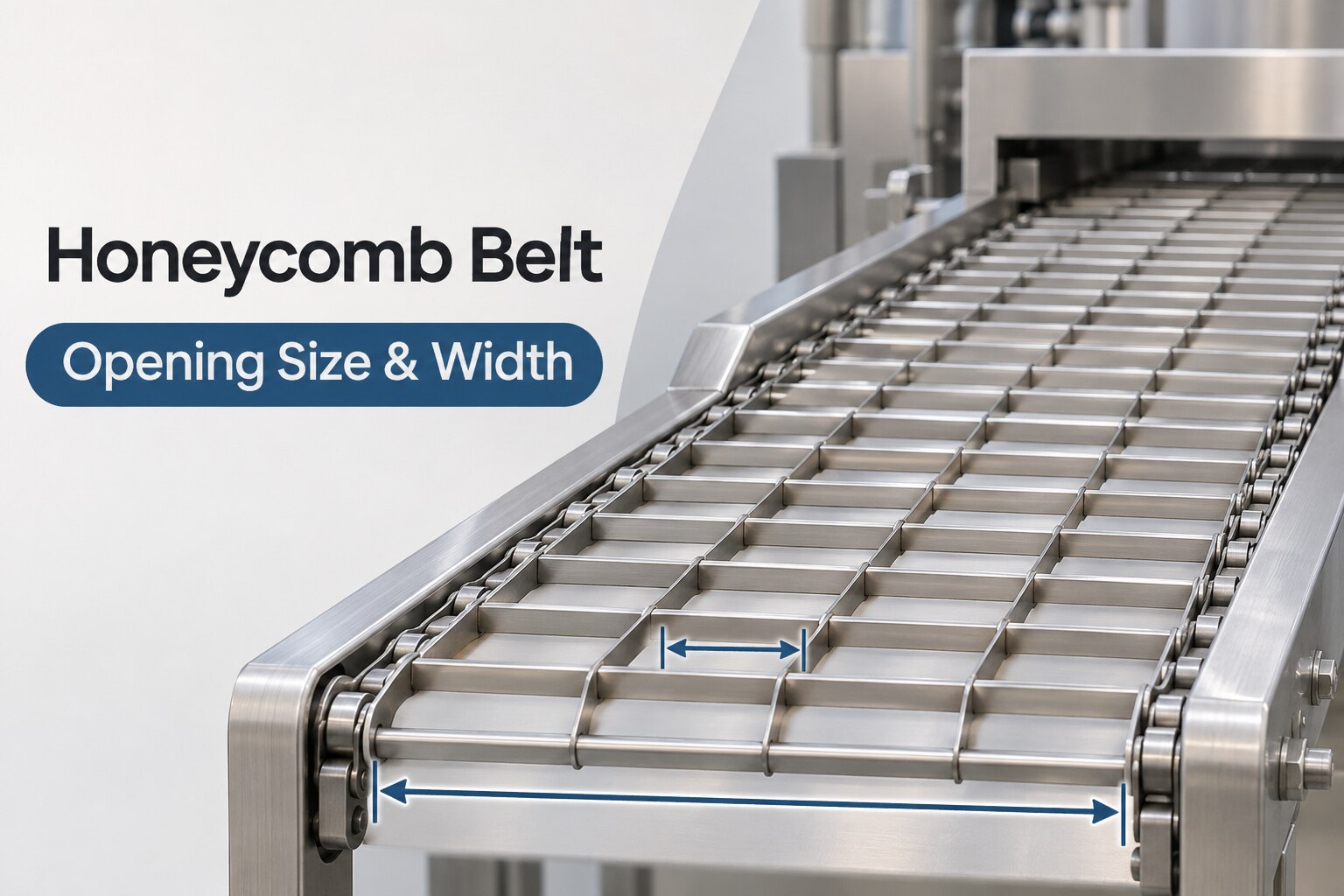
Choose the opening from the smallest product dimension that will touch the belt, then verify drainage, airflow, support and marking against the process. Choose width from the usable loading envelope and existing drive geometry, not from the conveyor frame’s outside measurement; by the end, you will have the measurements and quotation details needed to specify a replacement accurately.
Key takeaways
- Choose the opening below the smallest product dimension touching the belt.
- Separate clear aperture, pitch, wire diameter and open-area percentage.
- Measure the loading zone, not only the existing belt’s overall width.
- Include product size, temperature, speed, belt length and drive details in your quotation.
How do you choose a honeycomb belt opening from the product and process?
Choose the clear aperture against the smallest product dimension that can touch the belt during loading, transfer, turning or accumulation. If that dimension is smaller than the opening, the product can fall through, lodge between wires or suffer damage at a transfer.
Check small biscuits, confectionery pieces, chopped vegetables, meat portions and products that can tilt.
| Honeycomb belt opening size | Common nominal equivalent | Main trade-off |
|---|---|---|
| 12.7 mm | 1/2 inch | Strong support for small products; less drainage and airflow |
| 25.4 mm | 1 inch | General balance between support and passage |
| 38.1 mm | 1-1/2 inches | More drainage and air passage; less product support |
| 50.8 mm | 2 inches | Suits larger, stable products and strong process flow |
| 76.2 mm | 3 inches | Maximum passage; high risk for small or unstable products |
Ask whether the quoted figure is an exact metric aperture or an inch nominal size converted to millimetres. A larger opening improves water drainage and air or gas passage for washing, frying, baking and drying, but only when the product cannot sag, tip or fall through.
A tighter opening supports small products and reduces belt marking, yet it can restrict water removal, airflow and crumb discharge.
Before selecting honeycomb conveyor belt sizes, record:
- Product length, width, thickness, weight, orientation, spacing and residence time
- Required drainage or airflow condition, rather than only the product category
- The smallest dimension exposed during transfers and accumulation
State the required process passage and test the product at operating speed.
What do opening, pitch, wire diameter and open area each mean?
A honeycomb belt opening size is the clear passage between adjacent flat-wire spirals, not the complete belt specification. Pitch is the repeating distance from one spiral position to the corresponding position on the next; it is not the clear aperture.
Wire diameter describes the spiral wire thickness, while cross-rod diameter describes the rod linking and driving the spirals.
| Term | What it means | Why it matters |
|---|---|---|
| Opening | Clear passage between adjacent spirals | Determines whether products, crumbs, water or air can pass |
| Spiral pitch | Repeating distance between corresponding spiral positions | Affects belt geometry and sprocket engagement; it is not aperture |
| Wire diameter | Thickness of the spiral wire | Affects support, marking, strength and open area |
| Cross-rod diameter | Diameter of the linking and driving rod | Must match the drive and affects the smallest product passage |
| Open-area percentage | Proportion of the belt surface that is open | Indicates drainage and airflow, but also reduced product support |
Two belts with the same nominal opening can therefore differ in airflow, drainage, load capacity and product stability. For a tray or flat product, compare contact stability and marking; for crumbs, wash water, oil or heated air, compare the required passage with the open-area figure.
Ask for these dimensions on the drawing:
- Opening, spiral pitch, wire diameter, cross-rod diameter and total belt thickness
- Actual smallest passage around cross rods and edge construction
- No-load dimensions, belt width and edge-to-edge squareness
A product that clears the nominal aperture can still snag when it lands diagonally or bridges two wires. Test a sample at its operating orientation and speed before approving a wire belt for processing lines.
How should you calculate belt width for the actual loading zone?
Measure the conveyor’s inside width, but do not order a belt equal to that measurement. Calculate from the loading envelope instead:
1. Measure the widest product arrangement, including its orientation and spacing. Define the usable product width between the side guides, then add only enough side clearance to prevent rubbing, trapping and edge damage.
2. Subtract the width consumed by chain edges, reinforced edges, guide strips and other edge construction. A belt wider than necessary adds weight and drive load and creates more opportunity for tracking problems. A narrow belt leaves edge dead zones and can force accumulation against the guides.
3. Specify the finished belt width in millimetres and identify the reference: inside-edge width, outside-edge width or nominal spiral width. State the permitted width tolerance in millimetres and the maximum permitted edge-to-edge squareness error, measured as the difference between the two diagonals.
4. Confirm the belt’s position against the frame, guide rails, transfers and loading chute on a straight-running line. If an imported design uses inches while the Mumbai frame uses millimetres, write both nominal and measured values on the request.
5. Check more than honeycomb conveyor belt sizes. Confirm that the belt engages the existing sprockets, cross rods or drive arrangement correctly; width alone does not establish interchangeability. Record these details for honeycomb belt size for selection in mumbai.
Which measurements must you take before replacing an existing belt?
Measure the existing belt before choosing a honeycomb belt size for selection in Mumbai. Record width at several points, overall length or centre-to-centre shaft distance, spiral pitch, wire diameter, cross-rod diameter and edge style.
| Measurement | Record | Why it matters |
|---|---|---|
| Belt | Width, length, pitch, wire diameter, cross-rod diameter, edge style | A width match cannot correct the wrong pitch or rod size |
| Sprockets | Tooth spacing, tooth count, tooth form, width, and spacing between sprockets across each shaft | Incorrect geometry prevents positive engagement |
| Shafts and frame | Shaft diameter, bore, keyway arrangement, shaft-to-shaft layout, take-up travel and belt-travel direction | The replacement must fit the drive and track through its adjustment range |
Photograph the belt edge, cross-rod connection and sprocket engagement. Use measurements, not photographs, as the quotation basis. Positive drive through cross rods and matching sprockets means a wire belt for processing lines can fail even when its width is correct.
For heated equipment, provide operating, start-up and cleaning temperatures, plus the temperature gradient across the belt. Room-temperature dimensions are insufficient because expansion changes tension and tracking. For Mumbai washdown or coastal service, state cleaning chemicals, chloride exposure and drying conditions; choose 304 or 316 stainless steel from that exposure.
Request a dimensional drawing and verify opening, width, squareness, sprocket engagement and a trial run at operating speed before acceptance.
What should you include in a quotation request to a Mumbai supplier?
A quotation for a wire belt for processing lines must describe the process, not just name the equipment. State product dimensions and weight, orientation, spacing, belt speed, residence time, operating and cleaning temperatures, washdown chemistry, drainage or airflow needs, acceptable marking, and the risk of crumbs or small pieces falling through.
1. Define the belt requirement: target opening or open-area range, finished width in millimetres, width tolerance, inside-edge, outside-edge or nominal spiral width, edge style, belt length, material, and whether it must run on existing sprockets. For honeycomb belt size for selection in Mumbai, include the smallest product dimension that contacts the belt.
2. Provide the drive geometry: shaft layout, shaft-to-shaft distance, sprocket tooth spacing and tooth form, sprocket spacing across each shaft, cross-rod diameter, bore or keyway details, and available take-up travel. A belt with the correct width but incorrect sprocket engagement will not track or drive correctly.
3. Ask the honeycomb belt supplier in Mumbai for a dimensional drawing showing material designation, opening measured under no-load conditions, wire diameter, cross-rod diameter, finished width and edge construction. Laktas Wire Mesh Pvt.Ltd. Mr. Pramod K. can be included when matching a replacement to an existing line, but use this checklist with every supplier.
Approve the belt only after checking edge-to-edge width, squareness, product stability, tracking and a trial run at production speed. A request that says only “wire belt for processing lines” leaves the critical fit decisions unresolved.
Frequently asked questions
How do you choose a honeycomb belt opening size?
Compare the clear aperture with the smallest product dimension that can contact the belt during loading, transfer, turning or accumulation. Choose an opening smaller than that dimension to reduce fall-through, lodging and product damage.
What is the difference between opening, pitch, wire diameter and open area?
Opening is the clear gap between wires. Pitch is the distance from one wire centreline to the next. Wire diameter is the thickness of the wire. Open area is the percentage of belt surface occupied by gaps rather than metal.
How should you calculate honeycomb belt width?
Measure the actual loading zone and product path, then add the side clearance required by the guides, transfers and edge hardware. Confirm that the resulting width fits the conveyor frame, sprockets and drive arrangement.
Which measurements do you need before replacing an existing belt?
Record belt width, overall length, opening, pitch, wire diameter, edge construction, sprocket tooth pattern, shaft spacing, conveyor height and direction of travel. Photograph the belt edges and drive components.
What belongs in a quotation request to a Mumbai honeycomb belt supplier?
State the product dimensions and weight, process temperature, belt speed, cleaning method, operating load, belt width and length, opening, pitch, wire material, edge finish, sprocket details, delivery location and replacement deadline.