
A quotation that says only “2-inch Pall rings” leaves out the dimensions, material condition, hydraulic data and delivery terms that determine whether the packing will work in your tower. By checking the ring geometry, process duty, corrosion risk, quantity basis, documentation and sample before approval, you can compare suppliers on performance rather than nominal size alone.
Key takeaways
- Request exact dimensions, wall thickness, material and packing factor.
- Match Pall ring size with tower diameter, liquid load and gas velocity.
- Confirm corrosion resistance against the process fluid and operating temperature.
- Specify quantity, packing method, certificates and acceptance criteria in writing.
Define the Pall ring geometry, not just its nominal size
A “2-inch Pall ring” is not a complete specification. Nominal size identifies a category, not the geometry that controls open area, bulk density, pressure drop or hydraulic capacity.
Your pall ring order requirements should state:
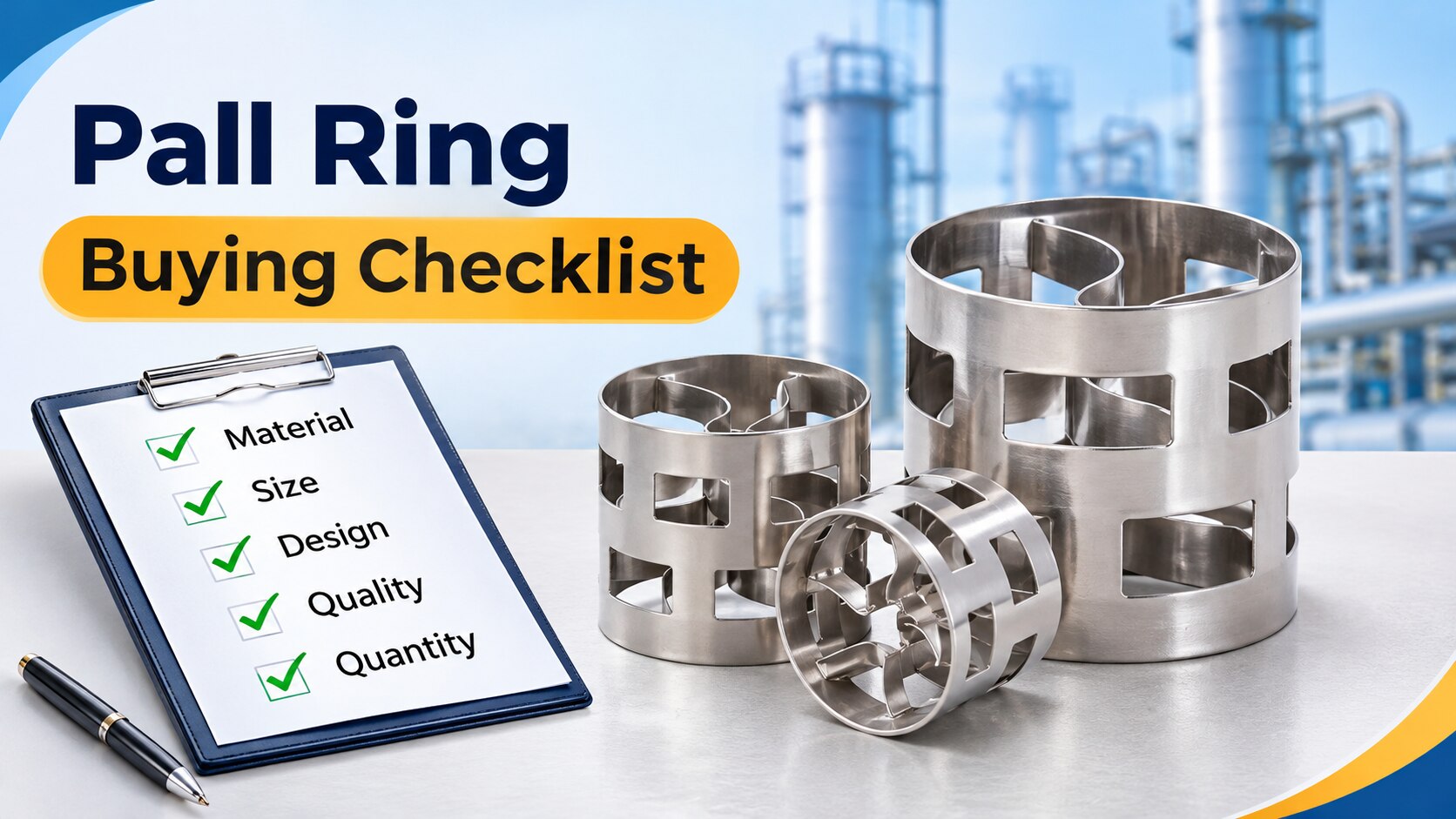
- Nominal size and measured outside diameter
- Ring height, measured across the ring axis
- Wall or strip thickness, with the permitted thickness tolerance
- Window, opening and inward-facing tab geometry, including tab length, width and forming angle
- Dimensional tolerances for outside diameter and height
- Material form, such as formed strip, and any welds, seams or joining method
- Surface condition, including burr limits, oil, scale, coating and cleanliness
Do not accept a catalogue photograph as the acceptance standard. Attach the approved dimensional drawing or datasheet to the purchase order, state the applicable size and thickness tolerances, and define rejection limits. Ask whether inspection covers every ring or a stated sample from the lot.
Obtain a production-lot sample before approving a large quantity. Compare its dimensions and thickness with the drawing, then inspect tabs, burrs, coating and cleanliness by sight and measurement.
Request geometric surface area, void fraction, bulk density, packing factor, pressure-drop curves and liquid-capacity data for the exact quoted geometry and material. Two suppliers’ rings with the same nominal size can have different open area, weight per cubic metre and tower performance.
Match ring size to the tower and its hydraulic duty
A supplier needs more than the packed-bed diameter to recommend a Pall ring size. Provide the tower’s geometry, internals and operating load so the selection reflects capacity, pressure drop and installation limits.
- Packed-bed diameter and planned bed height
- Absorber, scrubber, stripper or distillation service
- Gas flow and liquid flow, including minimum, normal and maximum rates
- Operating pressure, design pressure, operating temperature and vacuum conditions
- Allowable pressure drop across the bed
- Liquid density, viscosity, surface tension and chemistry
- Distributor type, liquid-distribution limits and any internal obstructions
- Support-grid opening, hold-down arrangement and the smallest permitted ring size
- Whether the service is flooding-limited or capacity-critical
| Selection | Hydraulic consequence | Installation consequence |
|---|---|---|
| Small Pall ring | Higher surface area but higher pressure drop and possible flooding at the design rate | Usually suits smaller columns; verify it cannot pass through the support grid |
| Large Pall ring | Lower pressure drop but less surface area and poorer transfer if the bed is too shallow | Can bridge, distribute poorly or strike distributors and internal obstructions |
| Matched size | Balances pressure drop, capacity and mass-transfer area at the stated rates | Fits the grid, distributors, manways and bed depth |
Equal nominal sizes can differ in open area, bulk weight and tab geometry between manufacturers. A search for pall ring for specifications before ordering in mumbai should not replace the process figures. Send the supplier the approved drawing and design case; then compare the recommended size against the tower’s flooding margin and pressure-drop limit.
Confirm whether the material will survive the process fluid
Do not accept “CS” as a complete material description. Put the cs pall ring details on the purchase specification before comparing quotations; carbon steel that survives dry service can fail quickly in a wet absorber or scrubber.
1. Name the exact carbon-steel grade or material specification, carbon content or grade designation, and mechanical requirements that matter during handling and installation. State whether the rings are plain carbon steel, galvanized steel, painted steel or another coated form. “Industrial grade” proves nothing about chemical compatibility.
2. Check the actual process fluid, gas contaminants, operating temperature, chloride concentration and acid concentration. Plain carbon steel is a poor choice for many wet, acidic or chloride-bearing services, even when its strength is adequate.
3. If the quotation proposes galvanized rings, specify the zinc-coating standard, coating type, minimum coating mass or thickness, and whether quoted dimensions and bulk density are measured before or after coating. Zinc protection is not stainless-steel corrosion resistance; low-pH or high-temperature service can strip the zinc layer.
4. Compare alternatives against the chemistry and temperature, not just purchase price. Stainless steel grades suit corrosive service only after confirming compatibility; polypropylene, PVDF or PTFE can suit selected chemical duties but bring different temperature, strength and cost limits.
5. Confirm the material with the column internals. Check that the support grid and hold-down arrangement suit the selected ring size; small rings can fall through openings, while large rings can bridge around distributors or obstructions.
Set the correct quantity, packing method and order documents
Define the quantity as installed packed volume: state the required cubic metres or filled bed volume, not only piece count or nominal tonnes. Rings settle and nest differently according to size, wall thickness and geometry, so ask the supplier to state the expected number of bags, volume per bag and approximate bulk weight.
1. Write the pall ring order requirements into the purchase order: nominal size, wall thickness, material grade, required quantity, bag or pallet dimensions, gross and net weight, delivery location and required delivery date.
2. Attach the approved drawing or datasheet. State size and thickness tolerances, the inspection method, whether checks apply to individual rings or a sample, and the rejection limits; a catalogue photograph cannot control a large lot.
3. Specify packaging suitable for local transport and identify whether the rings are virgin, reconditioned or mixed-lot stock. Prohibit substitutions without written approval, including changes to material, geometry, coating or manufacturing route.
4. Separate ex-works terms from delivered terms. Record the inspection point, dispatch lead time, responsibility for transit damage and replacement terms; “available in Mumbai” does not guarantee stock quantity or a dispatch date.
5. Require a certificate of conformity and, where needed, material test certificates linked to the production lot. The documents must connect the heat or batch number, material grade, dimensions, coating condition and quantity to the delivered bags.
Use samples, certificates and supplier terms to control acceptance
Before dispatch and receipt, make acceptance depend on a lot sample, traceable documents and written delivery terms—not on a catalogue image or “available in Mumbai.” Ask the pall ring supplier in mumbai to identify exactly what will be inspected and what happens if it fails.
1. Obtain a representative sample from the production lot. Compare individual rings with the approved drawing for nominal dimensions, wall thickness, tab or window geometry, burrs, coating and cleanliness. Record the size and thickness tolerances, and state whether inspection covers every ring or a defined sampling plan.
2. Attach the approved drawing or datasheet to the purchase order. Set rejection limits for out-of-tolerance dimensions, damaged rings, excess burrs and contamination; equal nominal size does not prove equal open area, weight per cubic metre or hydraulic behaviour.
3. Require a certificate of conformity tied to the delivered quantity. For carbon steel or another specified material, request a material test certificate when needed, with heat or batch number, grade, dimensions and coating condition matching each bag or pallet. Reject an undated generic certificate as lot evidence.
4. Write the commercial terms: ex-works or delivered location, dispatch date, lead time, bag or pallet dimensions, gross and net weight, inspection point, replacement terms and responsibility for transit damage. If Laktas Wire Mesh Pvt.Ltd. Mr. Pramod K. is quoting, attach this acceptance schedule to the order.
At receipt, match bag labels, counts, weights and visible condition against the documents before unloading the full consignment.
Frequently asked questions
What geometry details should you confirm for a Pall ring?
Confirm nominal size, outside diameter, height, wall thickness, openings, material, surface finish and packing factor. Nominal size alone does not define the ring.
How do you match Pall ring size to tower duty?
Compare ring size with tower diameter, gas velocity, liquid rate, pressure-drop limit and flooding margin. Smaller rings provide more surface area but increase pressure drop.
Which material details matter for Pall rings?
Check the material grade against the process fluid, concentration, temperature and cleaning chemicals. For CS Pall ring details, confirm carbon-steel grade, coating or lining, and corrosion allowance.
What should a Pall ring order include?
State size, material, quantity, packing method, delivery unit, drawings, test certificates, inspection requirements and the document used for acceptance.
How can samples and certificates control supplier acceptance?
Approve a representative sample, record its dimensions and appearance, request material and inspection certificates, and define how shortages, deformation or out-of-tolerance rings will be handled.