
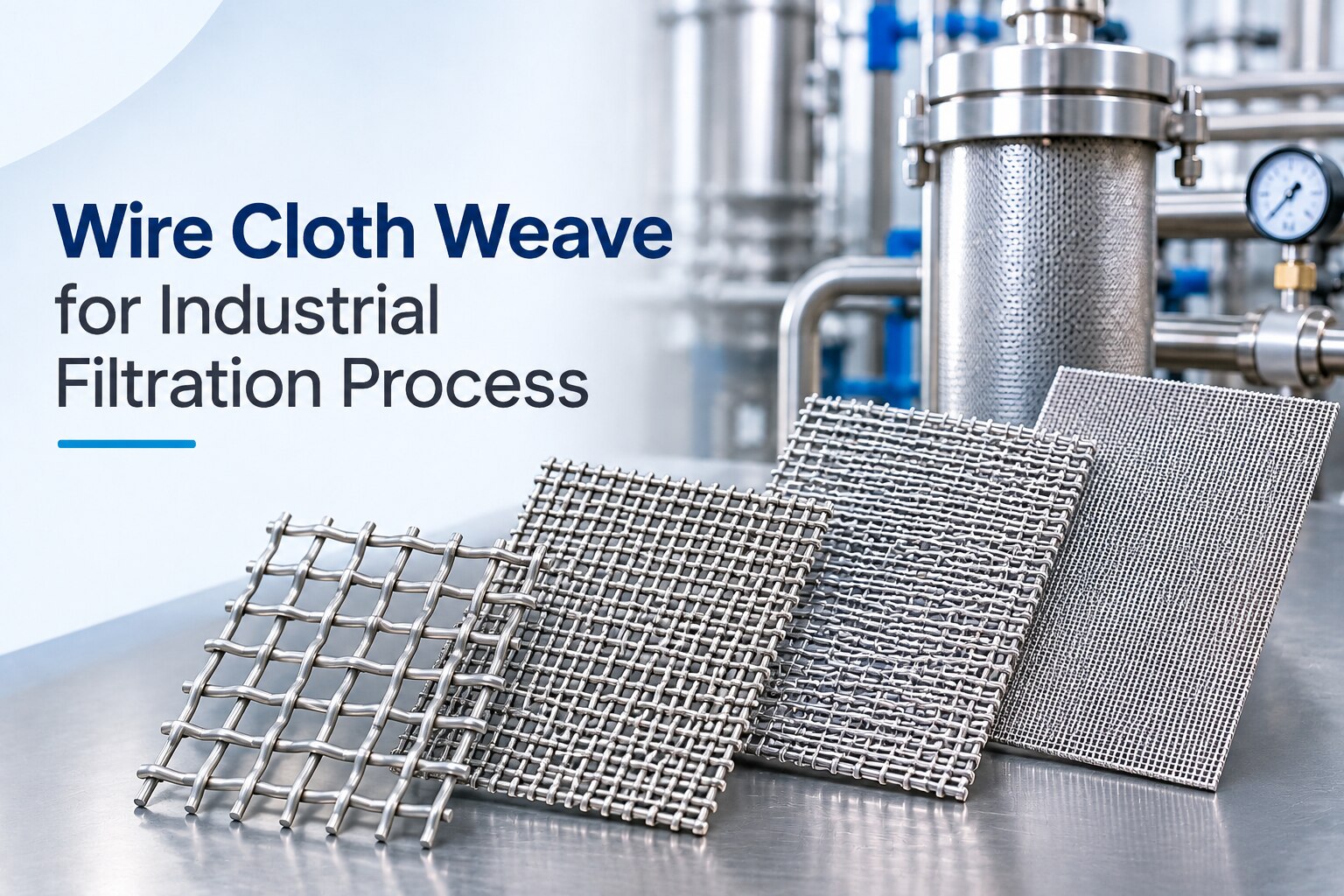
The right weave depends on more than mesh count: aperture shape, wire diameter, open area, filtration direction and pressure-drop limits determine whether a cloth will retain particles or choke the process. By matching those factors to your fluid, solids, temperature, pressure and cleaning cycle, you can choose a weave that meets separation targets without creating avoidable blinding or maintenance problems.
Key takeaways
- Specify aperture and filtration rating before mesh count.
- Use plain weave for square openings and moderate filtration duty.
- Choose Dutch weave for fine retention under higher pressure.
- Document fluid, particles, pressure, temperature and cleaning method.
Start with aperture, open area and filtration rating—not mesh count
Compare aperture, open area and filtration rating before comparing weave; mesh count alone cannot predict performance. For square plain-weave cloth, estimate clear opening in millimetres as 25.4 ÷ mesh count − wire diameter. Two cloths with the same mesh count can therefore retain different particle sizes.
Open area also changes with wire diameter. For square plain weave, estimate it as [opening ÷ (opening + wire diameter)]² × 100. Thicker wire improves strength, abrasion life and resistance to pressure distortion, but reduces aperture, open area and flow capacity.
Build your wire cloth weave comparison around these purchase details:
- State the required aperture, not only mesh count.
- Compare open-area percentage with the required flow rate and pressure drop.
- Identify whether the filtration rating is nominal or absolute, and request its test method.
- Record wire diameter, material, weave, width, length and edge condition.
- For Dutch or twill Dutch cloth, request the supplier’s stated rating because the openings are not simple square apertures.
- Use ISO 9044 and ASTM E2016 as reference points for dimensions, tolerances and inspection, not as substitutes for a complete specification.
Your enquiry for wire cloth for industrial filters should also name the process fluid, solids size and shape, temperature, pressure differential, cleaning cycle and corrosion exposure. Ask for a sample or data sheet that confirms every value before selecting the weave.
| Specification | Compare | Why it matters |
|---|---|---|
| Aperture | Clear opening in millimetres | Sets particle retention |
| Open area | Percentage of open surface | Indicates potential throughput |
| Rating | Nominal or absolute, with test method | Prevents misleading micron comparisons |
Plain and twill weave: when square openings are enough
Choose plain weave for general screening when you need regular square openings, predictable flow and straightforward cleaning. Each warp wire passes alternately over and under each weft wire, making the cloth easy to specify and inspect. It suits coarse-to-medium particle separation, protective screens and applications where blinding risk must stay low.
Choose twill weave when plain weave cannot provide the required aperture or strength. Its offset over-under pattern allows more wires per unit length, producing finer openings or a stronger cloth with comparable wire diameter. The tortuous path improves retention, but it also raises flow resistance, pressure drop and cleaning difficulty.
Plain weave and twill weave differ in these practical ways:
| Weave | Main advantage | Main limitation | Choose it when |
|---|---|---|---|
| Plain | Uniform square openings, high cleanability and lower flow resistance | Can blind when particles approach the aperture size | You need general screening, higher throughput or frequent washing |
| Twill | Finer openings or greater strength in a compact cloth | Higher pressure drop and more difficult cake release | You need tighter retention or resistance to pressure distortion |
Do not select either weave by mesh count alone. For square plain cloth, estimate opening as 25.4 ÷ mesh count − wire diameter in millimetres, then compare open area as well. A thicker wire increases strength and abrasion life but reduces aperture and throughput.
For wire cloth for industrial filters, state the fluid, particle size, pressure differential, flow rate and cleaning method. That wire cloth weave comparison prevents a fine cloth from becoming an expensive blockage.
Dutch and twill Dutch weave: fine retention under pressure
Choose Dutch construction when ordinary square mesh cannot retain fine particles without losing strength. Dutch plain weave uses coarse warp wires and many finer weft wires, giving high mechanical stability and fine retention under differential pressure. Its openings are not square, so specify the filtration rating and test method rather than relying on mesh count.
| Weave | Retention and stability | Flow, cleaning and best use |
|---|---|---|
| Ordinary square mesh | Regular apertures; easy to inspect and specify | Higher permeability and simpler cleaning, but can blind when particles approach the opening size |
| Dutch plain weave | Fine retention with strong support from coarse warp wires | Lower open area; suitable for pressurized liquid filtration and stable filter layers |
| Twill Dutch weave | Finest retention and strong resistance to cloth deformation | Higher pressure drop and harder cleaning; use for very fine filtration under pressure |
Twill Dutch weave permits finer wire combinations than Dutch plain weave. Choose it when particle escape is unacceptable and the process can supply the extra pressure needed to maintain flow.
For wire cloth for industrial filters, compare the stated filtration rating with pressure drop, required flow and cleaning method. Fine Dutch cloth improves retention but forms a denser cake, restricts permeability and can require backwashing or solvent cleaning.
If throughput and quick cake release matter more than very fine retention, ordinary square mesh remains the better choice.
Match the weave to liquid, gas, powder and process duty
Plain weave best fits open, washable screening; Dutch plain or twill Dutch fits fine retention under pressure. The right choice depends on whether throughput, particle capture, cake release or cleanability controls the process.
| Duty | Starting weave | Why and trade-off |
|---|---|---|
| Liquid filtration | Dutch plain | Retains fine solids with a controlled aperture; expect lower flow and harder cleaning than square mesh. |
| Gas filtration | Plain or twill | Offers low pressure drop for coarse dust; use twill when finer openings or greater cloth strength are needed. |
| Powder screening | Plain | Square openings are easy to inspect and clean, but particles near the aperture can cause blinding. |
| Hydraulic oil | Dutch plain | Holds fine contamination under pressure; confirm pressure drop against the pump’s flow requirement. |
| Polymer melt | Twill Dutch | Handles fine retention and pressure with strong cloth support; its low permeability increases differential pressure. |
| Food processing | Plain | Provides regular openings and straightforward washdown; select stainless steel when corrosion and hygiene control demand it. |
| Pharmaceutical service | Plain for screening; Dutch for fine filtration | Plain supports inspection and cleaning, while Dutch improves fine-particle retention; verify cleanability and product-contact material. |
A wire cloth weave comparison must include cake release and cleaning, not only nominal aperture. Twill gives finer openings and strength but creates more tortuous flow paths; Dutch weaves improve retention while sacrificing permeability. Request aperture, wire diameter, open area and filtration-rating basis, because ASTM E11 sieve-cloth compliance alone does not prove process performance.
Turn the process data into a purchase specification
Before ordering, give the supplier a process brief rather than only a mesh number. Use it to decide which wire cloth weave for industrial filtration in Mumbai fits the actual duty, then put the agreed details into the purchase order:
1. Name the process fluid or powder, operating temperature, solids size and shape, corrosion exposure, required flow rate, pressure differential and maximum allowable pressure drop.
2. Specify the weave—plain, twill, Dutch, twill Dutch or reverse Dutch—along with the clear aperture, wire diameter, material and open area. State whether the filtration rating is nominal or absolute, and identify the test method behind it.
3. Request a sample and data sheet showing the warp and weft arrangement. A mesh count is not a filtration rating, and two cloths with the same count can have different openings.
4. State roll or cut-sheet width, length, edge condition, seam requirements and the direction that must carry machine tension. This matters on pressure-filter belts and screens.
5. Ask for dimensional and visual inspection records referencing ISO 9044 or ASTM E2016. Treat ASTM E11 as a sieve-cloth reference, not proof of process performance, service life or absolute retention.
When comparing a wire mesh cloth supplier in Mumbai, ask how the selected cloth handles your cleaning cycle, cake release and blinding risk. Laktas Wire Mesh Pvt.Ltd. Mr. Pramod K. can confirm the warp/weft arrangement on a Dutch sample, because the weave name alone does not establish pressure capacity or filtration rating.
Related products
 | Wire Mesh ₹100 we manufacture wire cloth in ss 304 & ss 316 ,wire cloth mainly use for filtration process , we can manufacturer up to 500 mesh plain weave and dutch... View product → |
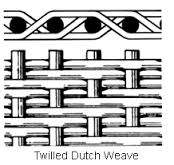 | ₹500 Manufacturer in Mumbai . Combines Dutch And Twill Weaving To Provide A Fine Mesh Filtering Cloth. View product → |
Frequently asked questions
Why should aperture and open area come before mesh count?
Mesh count alone cannot predict particle retention. Wire diameter changes the clear opening and open area, so compare both values before selecting cloth.
When is plain or twill weave enough for industrial filtration?
Use plain weave when square openings, straightforward sizing and moderate filtration duty meet the process requirement. Choose twill when you need a finer opening with greater wire support.
When should you choose Dutch or twill Dutch weave?
Choose Dutch weave for fine particle retention and higher pressure resistance. Twill Dutch weave suits finer filtration where greater strength and a higher wire count are required.
What process data belongs in a wire cloth purchase specification?
State the fluid or powder, target particle size, filtration rating, pressure, temperature, flow rate, chemical exposure, cleaning method, cloth material, dimensions and edge or support requirements.
Related product
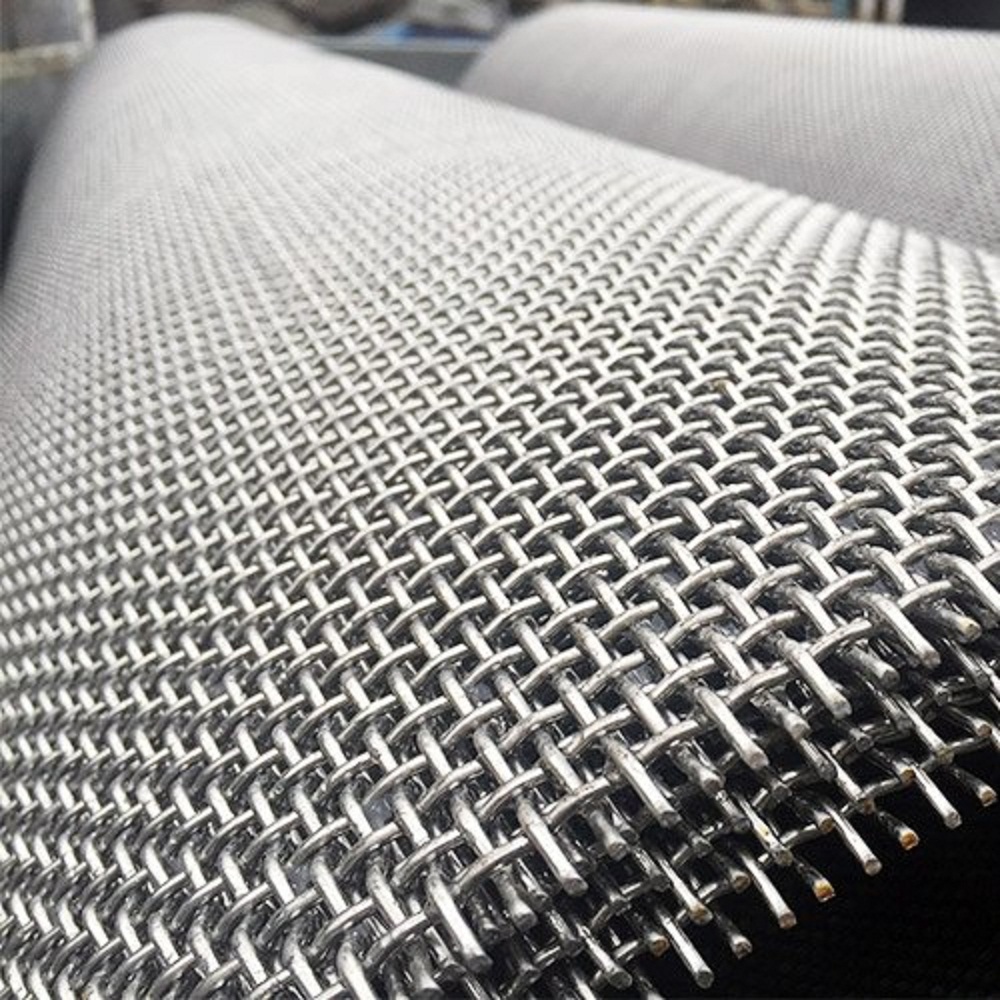 | Wire Mesh Laktas wire cloth is highly useful in filtration industries because it provides a reliable, durable, and customizable solution for separating solids... View product → |