
A poultry mesh specification must begin with the bird, the opening, the wire grade and the environment—not with the generic phrase “spring steel.” By following the manufacturing sequence and checking geometry, coating, heat treatment and inspection records, you can decide whether spring-tempered mesh is justified or whether a galvanized low-carbon alternative is safer and easier to maintain.
Key takeaways
- Confirm the wire grade, diameter, tensile strength and delivery condition.
- Match aperture size and mesh geometry to the bird’s age and size.
- Specify galvanizing or coating requirements for the poultry house environment.
- Request test reports, drawings, tolerances and traceability documents before purchase.
What “spring steel” means before the mesh is made
Spring steel is a specified wire grade and delivery condition, not a synonym for ordinary poultry wire. Low-carbon galvanized wire suits many static fences, while spring wire provides a higher elastic limit and better elastic recovery when a panel flexes or receives impact.
Before spring steel wiremesh manufacturing for poultry in Mumbai begins, record these decisions:
- Identify the standard: EN 10270-1 covers cold-drawn unalloyed spring wire, EN 10270-2 covers oil-hardened and tempered spring wire, and EN 10270-3 covers stainless spring wire.
- Request the wire designation, carbon or alloy grade, temper condition, diameter tolerance and batch identification. “Spring steel” alone does not identify the material.
- Check carbon content, tensile strength, hardness, elastic limit and elastic recovery. Tensile strength alone proves neither fatigue resistance nor resistance to permanent set.
- Match hardness to the job. Higher hardness and resilience help a panel survive repeated flexing or impact, but excessive hardness increases cracking during sharp bending, stapling or on-site forming.
- Obtain test values and an inspection certificate before approving spring steel mesh manufacturing. If the panel will flex repeatedly, specify a deflection or cycling test; do not rely only on a tensile certificate.
The selected delivery condition controls forming: high-carbon wire that has been fully hardened is difficult to bend without cracks or permanent distortion. Evaluate spring steel mesh manufacturing through these records, not through location alone; a supplier’s Mumbai address does not establish grade, fatigue performance or suitability.
How rod becomes a formed poultry mesh
A finished poultry roll or panel is built in stages because changing the order can leave hard wire cracked, permanently bent, or softened at a weld. In spring steel mesh manufacturing, agree the forming route before production starts: high-carbon wire is difficult to bend after final hardening, and post-forming heat can change its spring properties.
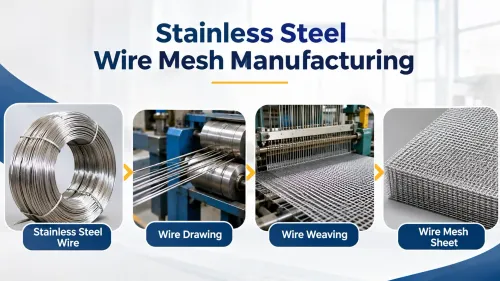
1. Descale the steel wire rod to remove mill scale, which would damage drawing dies and mark the finished wire.
2. Draw the rod through progressively smaller dies until it reaches the required intermediate diameter. Each pass reduces size and raises strength, so control lubrication and reduction.
3. Apply patenting or another specified heat treatment when the selected grade requires it. This restores a workable structure before further drawing.
4. Perform final drawing, then spring tempering, to establish the specified diameter, strength and elastic recovery.
5. Straighten the wire to remove coil memory. Cut, bend or form it into the specified panel geometry before joining.
6. Weave or weld the formed wires. Woven construction permits controlled flexibility; welded construction fixes each aperture and improves dimensional stability. For spring-tempered wire, control welding current, pressure and cycle time: excess heat can soften the heat-affected region, while insufficient heat creates a weak joint.
7. Trim the mesh, form selvage or edges, deburr projections, cut panels to length and apply the specified corrosion protection. Check that finishing has not collapsed apertures, exposed sharp ends or damaged the coating.
How aperture and geometry protect different birds
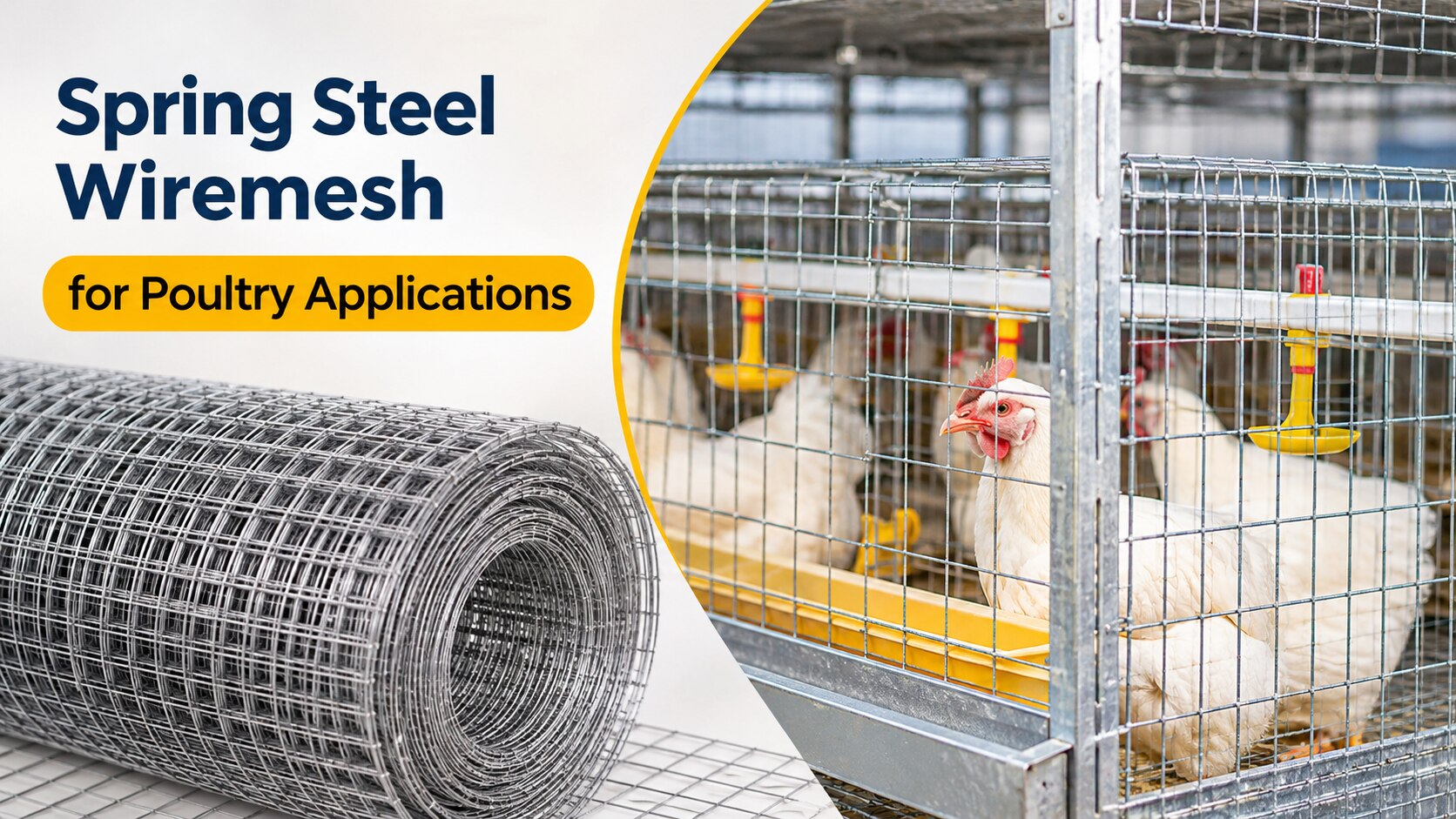
A chick guard needs a smaller clear opening than an adult-bird partition; quail also require tighter geometry than broilers, layers or breeders. A predator barrier must stop the relevant animal from reaching through, not merely retain the birds. For a spring steel wiremesh poultry farm installation, select wire diameter, aperture and panel size together.
- State the clear opening, wire diameter, aperture tolerance, mesh type, and roll or panel dimensions.
- Define pitch as centre-to-centre spacing, or specify the measurement method. “25 mm opening” is incomplete without wire diameter and proof that 25 mm means clear aperture.
- Choose geometry that keeps toes, heads and necks outside the opening. Check gaps at corners, doors and formed bends, where distortion can create larger openings.
- Orient welded or woven panels to limit sag. This matters in tall aviary panels, litter guards and ventilation guards.
- Set the panel length and edge arrangement so repeated gate movement does not pull openings apart.
Inspect finished mesh for collapsed apertures, oversized openings, broken welds, loose wires, burrs and sharp projections. These defects can trap a bird, snag feathers or cut workers.
The mesh must withstand pecking, impact, pressure from birds and repeated pressure washing without permanent set. For welded mesh, test representative joints and measure apertures after forming; a sound drawing cannot compensate for a softened weld or a distorted edge.
Choosing construction and corrosion protection for the poultry house
Choose the construction by the movement and abuse the poultry house will impose, not by the label “spring steel.” Spring steel prioritizes elastic recovery and fatigue resistance for flexing gates, guards or impact-prone panels; static partitions may be cheaper and easier to repair in galvanized low-carbon steel.
| Construction | Main behaviour | Suitable poultry-house use |
|---|---|---|
| Spring steel mesh | Recovers after flexing; resists permanent set | Moving gates, resilient guards and repeated-impact areas |
| Welded wire mesh | Fixed apertures; strong dimensional stability | Static partitions, cages and panels requiring accurate openings |
| Woven mesh | Tolerates local movement without a rigid joint pattern | Flexible screens and uneven installations |
| Hexagonal chicken mesh | Light netting with different edge and impact behaviour | Temporary or low-impact separation, not heavy predator barriers |
| Expanded metal | Slit-and-stretched sheet with rigid diamond openings | Rigid guards where separate-wire construction is unnecessary |
For a spring steel wiremesh poultry farm installation, compare bare spring steel, galvanized-before-fabrication wire, post-fabrication hot-dip galvanizing, electrogalvanizing and stainless steel. Post-fabrication hot-dip galvanizing covers intersections and newly cut edges more completely. Pre-galvanized wire can lose zinc at welds, sheared edges and scratches; electrogalvanizing has a thinner zinc layer than hot-dip material.
Manure, humidity, ammonia, dust, disinfectants and pressure washing accelerate attack around drinker lines, litter, manure belts and poorly ventilated corners. Specify:
- Coating type and coating mass
- Drainage and ventilation around the mesh
- Protected cut edges and repair treatment
If the mesh remains static, choose galvanized low-carbon steel when easier welding, cutting and field repair outweigh spring recovery.
What to request from a spring steel mesh supplier
A purchase order must identify the mesh precisely; “spring steel” or “poultry mesh” is not enough. Use this acceptance checklist:
1. State the construction: woven, welded or expanded. Specify wire grade and temper, carbon or alloy designation, wire diameter and tolerance, clear aperture, pitch, panel or roll dimensions, mesh orientation, coating type and coating mass.
2. Request the batch number, inspection certificate, and test records showing tensile strength or hardness. If the mesh will flex repeatedly, add a deflection limit or cycling test and method; tensile strength alone does not establish fatigue life or resistance to permanent set.
3. For welded mesh, require visual weld inspection, weld pull or shear testing, aperture measurement, and examination of the heat-affected region. Excess heat can soften the wire beside a weld, while insufficient heat creates a weak joint.
4. Before installation, inspect for burrs, sharp ends, open welds, loose wires, coating damage and collapsed or oversized openings. Reject material that can injure birds, snag feathers or cut workers.
5. Prohibit unapproved substitutions. A search for “spring steel wire mesh supplier in Mumbai” can return spring-temper woven cloth, high-carbon netting, stainless spring mesh or ordinary galvanized poultry mesh.
Evaluate Laktas Wire Mesh Pvt.Ltd. Mr. Pramod K. by requesting these exact construction, grade, temper, coating and inspection documents for the intended poultry use, not by relying on a product label.
Frequently asked questions
What does spring steel mean in poultry mesh?
Spring steel identifies a wire grade and delivery condition with a higher elastic limit and better elastic recovery than ordinary low-carbon wire. It is not simply another name for poultry wire.
How is spring steel converted into poultry mesh?
The process starts with spring-steel rod or wire, followed by drawing to the required diameter, straightening, cutting or feeding, and forming into the specified welded or woven mesh geometry. The finished mesh is inspected for aperture, wire diameter, welds and dimensional accuracy.
How do aperture and mesh geometry protect poultry?
Choose openings small enough to prevent heads, feet or wings from becoming trapped while allowing ventilation and waste passage. Compare aperture width, height, wire diameter, panel stiffness and edge finishing against the bird’s size and the installation location.
Which corrosion protection suits a poultry house?
Select the protection after considering humidity, manure, cleaning chemicals and ventilation. Ask whether the mesh is galvanized before or after forming, or supplied with another coating, and verify coating details on the specification or test report.
What should you request from a spring steel mesh supplier?
Request the wire grade, diameter, tensile or spring properties, aperture dimensions, mesh construction, coating specification, tolerances, drawings, inspection results, batch traceability and packing details.